Startup Marketing Plan: A One-Page Framework (2026)
A one-page 2026 framework for connecting your best-fit customer, promise, proof, channel bets, weekly actions, budget, and learning decisions.
Practical guides, examples, frameworks, and checklists for validating an idea, finding customers, launching, and growing with less guesswork.

A one-page 2026 framework for connecting your best-fit customer, promise, proof, channel bets, weekly actions, budget, and learning decisions.

A focused 2026 launch calendar that moves from customer proof to message, distribution, launch day, and a measured follow-up loop.

A 2026 interview guide for turning real customer experience into specific, permissioned proof without leading the witness or polishing away credibility.

A 2026 onboarding system for moving new customers from signed agreement to first value with clear owners, evidence, and recovery steps.

Ten practical 2026 growth-loop types across product, content, partnerships, referrals, and sales, with the signals that show whether each can compound.

A founder-ready 2026 system for choosing the right ask, reward, handoff, tracking, and follow-up without manufacturing spam.

A 2026 buyer-trust system built on a useful expertise wedge, practical demonstrations, honest evidence, and the right next conversation.

Ten founder-sized distribution plays for 2026, moving one useful idea through sales, email, partners, communities, media, search, and live conversations.

A practical 2026 writing sequence for turning customer language into a clear promise, credible proof, and one decisive next step.

Ten concrete 2026 B2B pilot structures with buyers, boundaries, prices, evidence targets, and conversion paths.

A practical 2026 path from problem interviews to deposits, paid pilots, or preorders—without pretending an unfinished product already exists.

A behavior-first 2026 interview guide for separating polite interest from urgent problems, active budgets, real authority, and concrete next steps.

Ten adaptable 2026 outreach messages for customer research, pilots, sales, partnerships, and reactivation—plus a simple way to test what works.

A 2026 call-by-call operating system for founders who need early revenue, sharper positioning, and a sales motion another person can inherit.
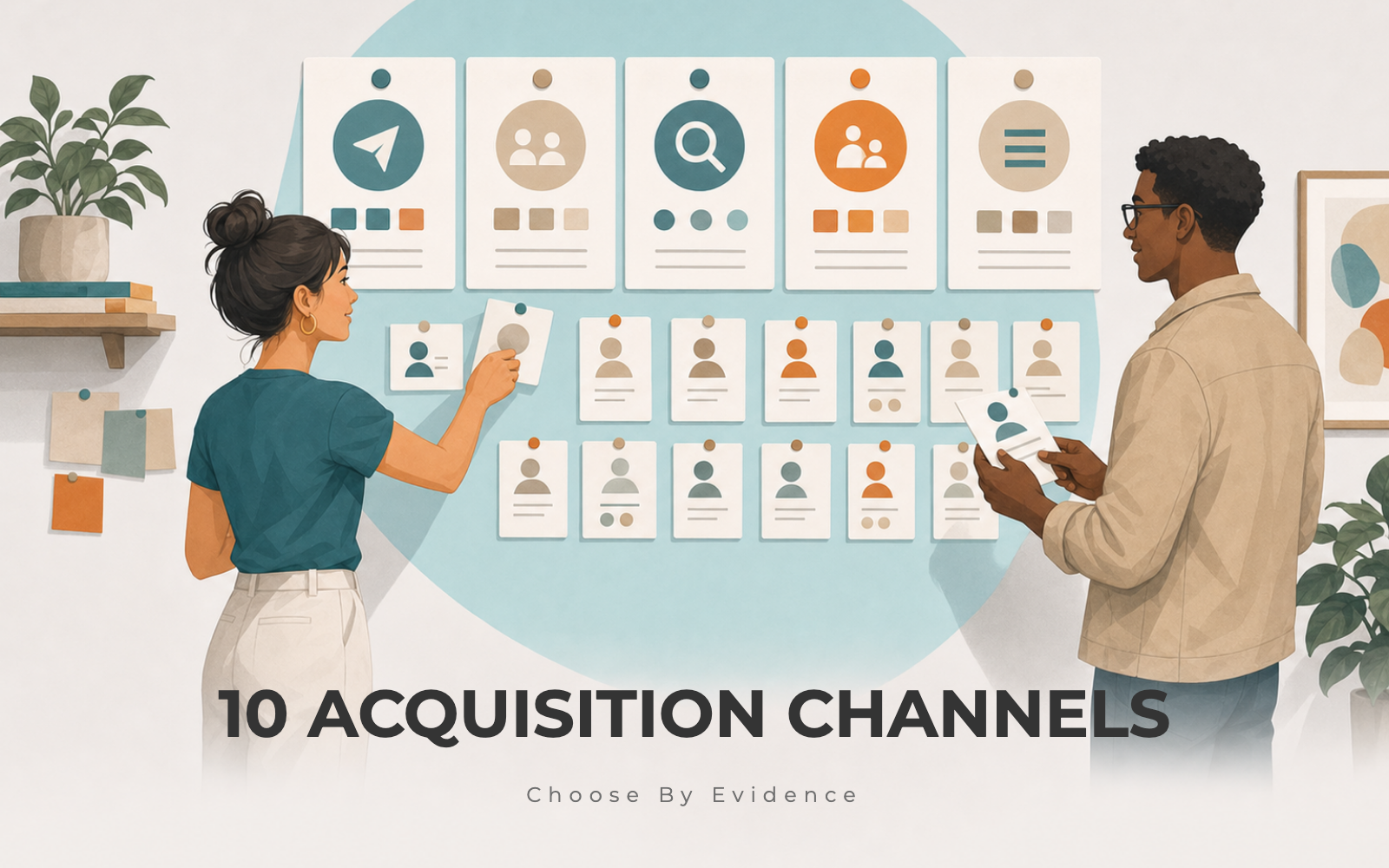
A 2026 milestone-based customer acquisition plan for turning founder conversations into one dependable growth loop.

Ten practical 2026 positioning examples showing how startups can choose a category, competitive alternative, best-fit buyer, difference, and proof.
A 2026 example library for turning customer pain, desired progress, alternatives, and proof into a value proposition buyers can understand and test.

Ten practical 2026 B2B customer profiles that combine company fit, urgency, buying triggers, access, and disqualifiers instead of relying on firmographics alone.

A practical 2026 route from target segment and urgent problem to offer, sales motion, launch experiments, and evidence for the next growth decision.

A 2026 field guide to choosing startup growth channels by customer behavior, test speed, economics, and the evidence each experiment should produce.

A 2026 operating-system guide for keeping startup context, priorities, learning loops, and weekly execution in one place.

A 2026 founder-friendly comparison of simplicity, liability boundaries, admin work, and when to get professional advice.

A 2026 guide to the proof investors, advisors, and founders should look for before a pre-seed round.

Ten complete, annotated pitch scripts for customers, pilots, demos, investors, partners, recruits, internal sponsors, and programs.

A 2026 content system for turning one customer insight into posts, emails, sales copy, and proof without repeating yourself.

Ten landing-page tests mapped to the audience, promise, traffic source, call to action, evidence threshold, and next decision.

A 2026 guide to turning repeated service delivery into software only after the workflow, buyer, and value are proven.

Ten AI-assisted businesses compared by buyer, revenue model, delivery economics, human workflow, validation test, and operating risk.

A 2026 plan for validating a business in small weekly sprints while protecting focus, energy, and judgment.
A 2026 startup checklist for turning an idea into a validated offer, first customers, and a basic operating rhythm.

Ten pre-build questions for reconstructing the customer's real workflow, constraints, exceptions, and smallest useful test.

A 2026 decision framework for choosing a business idea based on evidence, reach, and the first test you can run.

Ten responsible product-like tests showing the user experience, manual operation, disclosure boundary, success metric, and automation decision.

Ten narrow software ideas mapped to a buyer, current workaround, pricing unit, reach channel, manual test, and build risk.

Ten AI-assisted services with a defined buyer, deliverable, human review step, and path from first project to repeatable offer.

A 2026 founder playbook for reaching ten real customers through focus, useful outreach, and small proof loops.

A 2026 validation process for founders starting from zero reach, using direct customer learning instead of audience size.

Ten concrete concierge MVPs with customer inputs, manual delivery steps, pricing hypotheses, evidence thresholds, and automation decisions.

Ten concrete service packages with fixed inputs, deliverables, turnaround, exclusions, pricing logic, and capacity safeguards.

Ten beginner-friendly online business models compared by first offer, delivery load, sales path, and evidence of demand.

A 2026 solo-founder guide to practical offers, AI-assisted delivery steps, validation signals, and risks to check before scaling.

A 2026 field guide for matching the MVP format to the real startup risk before committing to a full AI product.

A 2026 playbook for choosing beginner-friendly ideas with reachable customers, manual MVPs, and clear validation signals.

Compare solo and team-building entrepreneurship across ownership, hiring, capital, growth, risk, and day-to-day operations.

Compare 10 practical entrepreneurship models by ownership, growth, capital, operations, and risk—then use a decision table to choose a path that fits.

Build investor, customer, or partner pitches around a clear audience, problem, evidence, plan, and specific ask—with complete scripts and a reusable template.

Compare a sole proprietorship's simple start and direct control with personal liability, ownership, tax, funding, and continuity limits using current U.S. sources.

Compare 10 realistic sole proprietorship examples by startup cost, liability exposure, customer type, and signs that a different structure may fit better.

Build a driver-based startup financial model that connects customers, revenue, costs, cash, runway, break-even, and sensitivity with one worked example.

Turn five useful solopreneur mindsets into weekly behaviors for customer learning, risk control, resilience, focused execution, and sustainable growth.

Use a lean portfolio-management rhythm to limit work in progress, connect initiatives to evidence, surface risks, and stop projects that no longer support the startup's constraint.

Understand pre-money, post-money, dilution, SAFEs, and option pools—and avoid treating an early-stage valuation as a precise or guaranteed measure of company value.

Pre-seed and seed are market labels, not legal classifications. Compare typical evidence, investors, instruments, milestones, and use-of-funds logic.

Ten practical ways a one-person business can become easier to choose through focus, proof, delivery design, customer experience, and a clear point of view.

Choose the right Six Sigma tool for the question: map a process, collect data, prioritize defects, test causes, assess risk, or monitor performance.

Learn how Define, Measure, Analyze, Improve, and Control turn an existing process problem into a measured improvement and a sustainable operating standard.

A process map explains how a defined workflow operates; a value stream map shows end-to-end material and information flow, delays, and improvement opportunities.

A prototype explores how a concept should work; an MVP tests a customer or business hypothesis through real use. Compare purpose, evidence, scope, and risk.

Understand what pre-seed funding is, what evidence an early founder can prepare, how common instruments differ, and how to run a careful investor process.

Move from problem evidence to commitment, paid pilots, repeat use, and scalable economics with a practical validation sequence and honest limits for every signal.

Build a bootstrap plan around customer-funded learning, cash runway, staged commitments, and clear signals for staying self-funded or seeking capital.

Generate product ideas from customer evidence, score them by consequence, reach, feasibility, and testability, then leave the workshop with one owned experiment.

Explore 10 practical MVP formats—from concierge delivery and paid pilots to single-feature software—with the hypothesis, evidence, and failure mode for each.

Prepare a startup for investor due diligence with a practical data-room checklist, workstream owners, issue log, process stages, and founder reverse diligence.

Compare Lean and Six Sigma by problem type, evidence, tools, and operating cost—then choose a lightweight improvement method that fits the process.

Build a durable one-person business by tightening the offer, pricing for capacity, protecting cash, choosing one acquisition system, and reviewing the right numbers weekly.

Micropreneur usually describes someone who deliberately builds a small, focused business. Learn how it differs from solopreneurship and a microbusiness.

Build a startup hiring process around a real capacity constraint, a job scorecard, structured assessment, bias safeguards, and a measurable 30-day outcome.

An iterative process repeats a cycle to revise an existing result using evidence. Learn how it differs from incremental delivery and when startups should use both.

Federal trademark registration can provide important US benefits, but it is optional, scoped, and not self-enforcing. Learn what registration does and does not do.

Apply Steve Blank’s four-stage Customer Development model with hypotheses, fieldwork, evidence gates, and clear links between discovery, validation, creation, and company building.

A sole proprietorship is a business form; S corporation status is a federal tax election for an eligible entity. Compare liability, payroll, tax, and filing implications.

Idea generation is the deliberate production of multiple possible solutions before evaluation. Use practical methods, prompts, and a worked startup exercise.

Combine outcome-focused OKRs with short learning cycles using complete startup examples, a weekly review cadence, and guardrails against common failure modes.

A proof of concept tests feasibility, a prototype tests a proposed experience, and an MVP tests customer value. Choose from the uncertainty—not a fixed sequence.

A seed round is an early financing from investors. Learn how SAFEs, notes, and priced equity work, what investors review, and how founders prepare.

Prepare a seed round by defining the milestone, building an evidence-backed investor narrative, running a focused pipeline, organizing diligence, and reviewing deal terms with counsel.

Learn what US founders mean by seed grants, how grants differ from contracts and equity, and how to screen official opportunities before applying.

Compare angels and venture capital funds by source of capital, stage, decision process, governance, timing, terms, and fit—without relying on misleading check-size rules.

Compare CEO and COO responsibilities, reporting lines, decision rights, structure variants, and the evidence that a startup actually needs an operations executive.

Study 10 documented Blue Ocean strategic moves, see how each changed buyer value, and learn why a famous company is not automatically a blue ocean today.

Understand how a U.S. startup convertible note works, what happens at financing or maturity, how caps and discounts interact, and which terms require legal review.

A solopreneur owns and leads a business without building a permanent employee team. Learn how the model differs from freelancing and micropreneurship.

Use Doblin’s 10 Types of Innovation to find opportunities beyond product features, combine complementary moves, and choose a test your startup can run now.

Compare a U.S. limited liability company with general, limited, and limited-liability partnerships—and separate state-law structure from federal tax classification.

Evaluate U.S. startup debt by repayment source, total cost, collateral, guarantees, covenants, and downside—not by the promise of avoiding dilution.

Lack of experience is not a credential, but it can encourage better questions. Learn how first-time founders turn openness into disciplined customer evidence.

Understand the two common meanings of equity partner: an owner in a professional firm and an informal startup label for someone receiving ownership or future equity.

Kristen Gail Andersen explains how founders can connect positioning, customer reality, and company purpose in a growth narrative that people can understand and use.

A separate business account is often useful for sole proprietors, but requirements vary. Learn what it does, what it does not do, and how to prepare.

Begin by estimating one-time and monthly startup costs, setting a safe funding target, separating the money, and automating a contribution you can sustain.

A startup pivot is a deliberate change to a fundamental hypothesis based on evidence. Use this framework to decide whether to hold, adjust, pivot, or stop.

Forecast a product idea with mechanism-specific formulas, evidence grades, base and downside scenarios, cost estimates, ethical demand tests, and explicit uncertainty.

A practical guide to startup ownership, cap tables, common and preferred stock, options, vesting, dilution, and the questions founders should review with advisers.

Understand when a U.S. business grant is not repaid like a loan, when funds may be disallowed or recovered, and what to verify before accepting an award.

Lead a remote startup with explicit decisions, async updates, meeting rules, timezone handoffs, one-to-ones, security boundaries, and an operating cadence that does not depend on constant calls.

Separate activity, output, outcome, and learning with a practical startup scorecard that turns busy weeks into evidence-based decisions.

Use customer problems, personal access, and small evidence tests to generate, score, and shortlist business ideas without waiting for inspiration.

Use the Blue Ocean Strategy Four Actions Framework to decide what to eliminate, reduce, raise, and create—then turn the grid into a testable offer.
Most founders are overworked, under-resourced, and forced to build without the operating sequence. 100 Tasks AI turns Martin Bell's 120+ launch process into a 100-task checklist, AI co-founder, Powersheets, and dashboard so you can launch and scale 3-5x faster.