 Martin Bell10 Min ReadPublished Jul 21, 2026
Customer Interview Notes Template (With a Worked Example)
A one-sheet-per-interview format for founders: capture verbatim quotes, problem severity, and real workarounds, then synthesize five conversations into a build, change, or stop decision.
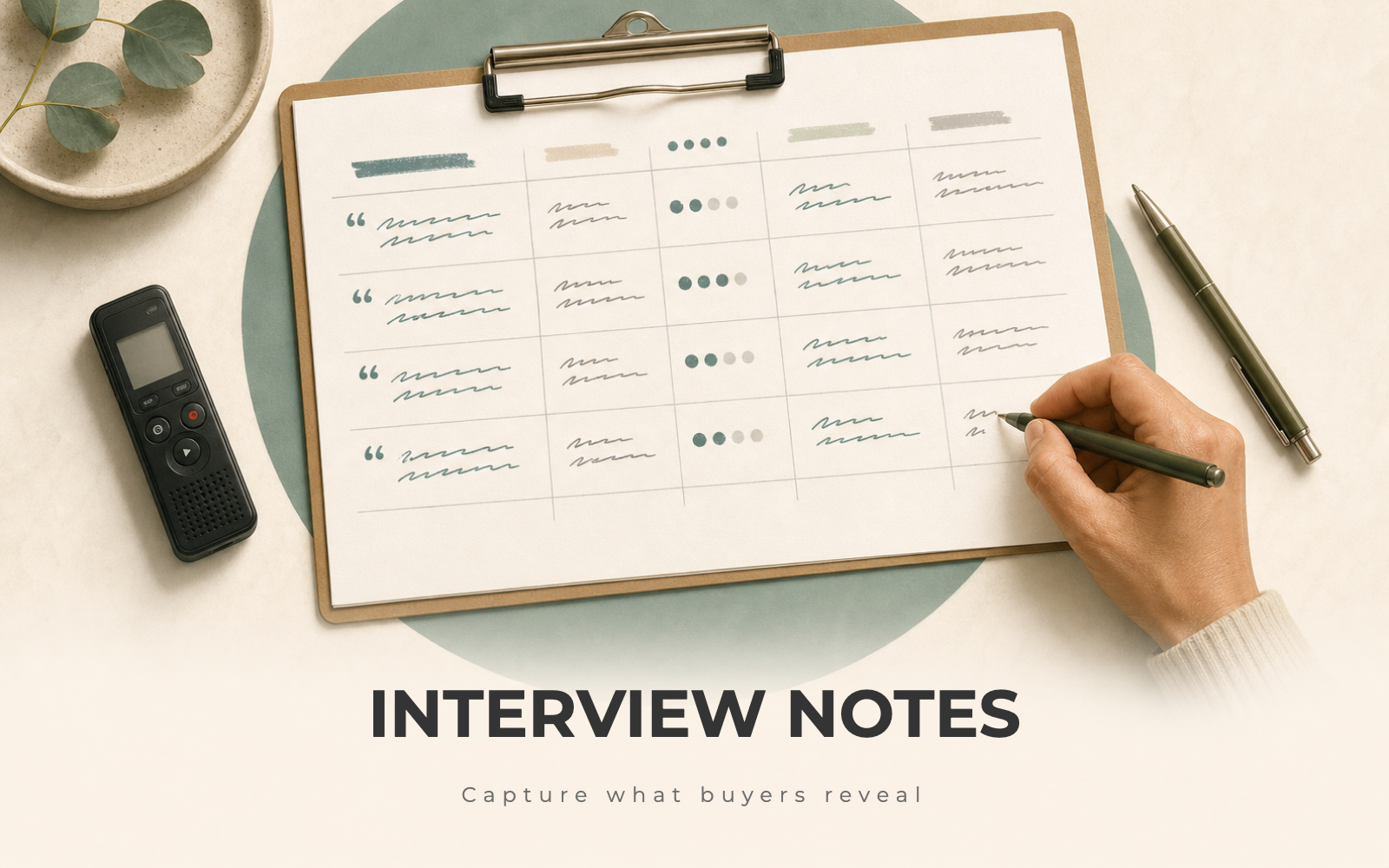
You finish a customer interview feeling encouraged. A week later, the only thing you clearly remember is the part where they said "I'd definitely use this." The doubts, the tool they already pay for, the exact phrase they used for the problem — gone, or quietly reshaped into a version that flatters your idea. Memory is not a neutral recorder. It keeps what confirms what you already believe.
A notes template fixes that by forcing the same fields for every conversation, including the inconvenient ones, and by separating what the person actually said from what you hope it means. It also makes synthesis possible: you can only see a pattern across ten interviews if all ten were captured the same way.
This is the discipline I insisted on before we built anything at Rocket Internet: customer conversations came before product, precisely so the notes from them could be scored, not just remembered. A sheet that names the job someone is trying to do, the pain, a severity number, and what they already do instead can be ranked against every other sheet you collect. A sheet that just says they seemed excited cannot — it only flatters whoever wrote it. The template below is built to force the first kind.
This post gives you a copyable one-sheet-per-interview template, a rule for filling each field honestly, a fully worked example for a single interview, and a synthesis grid that turns five scattered sheets into one build, change, or stop decision. It pairs with the process for running the interview itself; the notes are where each conversation gets logged onto the evidence ladder that separates opinion from commitment.
Why a template beats memory and a blank page
Three failures happen without a fixed format.
Confirmation bias edits the transcript in your head. Unstructured recall over-weights praise and drops the "but." A template that always asks for severity, the current workaround, and objections makes you write down the parts your idea would rather forget.
You cannot synthesize what you captured inconsistently. If interview one records a quote, interview two records your summary, and interview three records a feature request, there is nothing to line up. Identical fields on every sheet are what let you count how many people raised the same problem.
Observation and interpretation blur together. "They loved the dashboard" is your read. "I only open it on Fridays" is what they said. When those live in one sentence, your conclusion contaminates your evidence. The template keeps them in separate fields on purpose.
The customer interview notes template
Use one sheet per interview. Fill it live if you can type without breaking eye contact, or within an hour while the words are still exact. Copy this table:
| Field | What to capture (and how to keep it honest) |
|---|---|
| Date & interview # | When it happened and which number in this round. Lets you see when patterns stabilize and you can stop. |
| Segment | The market slice this person represents ("4-person bookkeeping firm"), not just a company name. You cluster by segment later. |
| Role & decision power | Their title, and whether they can buy, influence, or only use. Note who else must sign off. |
| Trigger / context | What made the problem live recently, and what prompted this interview. "No trigger" is itself a finding. |
| Problem in their words | The problem in their language, not your category. Write the phrase they actually used. |
| Severity (1–5) | How much it costs them, on the scale below. Score their behavior, not your excitement. |
| Current workaround + spend | What they do instead today, and what it costs in money and hours. "Nothing" usually means low severity. |
| Verbatim quotes | Their exact words, in quotation marks, uncleaned. Keep the two or three that carry the most signal. |
| Buying signals | Observable intent: money already spent, a workaround they built, a budget number, a "when can I start?" |
| Objections / risks | What would stop them buying or adopting: switching cost, trust, other stakeholders, budget timing. |
| Agreed next step | A concrete action with an owner and a date. "Stay in touch" does not count. |
| Your interpretation | Your read — clearly labeled as yours, so it never contaminates the evidence above. |
Score severity against fixed anchors so the number means the same thing on every sheet:
- Mild annoyance, no real consequence.
- Irritating, but they tolerate it and have no workaround.
- Costs real time or money; they actively work around it.
- Painful; they already spend money or people on it and would switch for a good option.
- Urgent; they are actively searching for or building a fix right now.
How to fill the fields honestly
Most of these are obvious. Four of them are where founders quietly cheat.
Problem in their words. Resist translating "I feel like a debt collector at month-end" into "inefficient AR follow-up." Category language hides whether two people actually share a problem. If you must interpret, do it in the interpretation field, not this one.
Verbatim quotes. Write what they said, not a tidier version. A real quote can be cited, re-read, and argued with; a paraphrase is already your opinion wearing their voice. If you genuinely cannot recall the exact words, write "(paraphrase)" so future-you knows the difference. The pre-build validation questions that reconstruct a real workflow are built to produce quotable, specific answers instead of opinions.
Current workaround + spend. This is your severity lie detector. People overstate how much a problem hurts and understate how little they do about it. Capture both the money — tools, contractors, staff time — and the hours per week or month. Someone paying $1,600 a month for an admin to do the job by hand is telling you far more than someone who calls it "a huge problem" and does nothing.
Buying signals. Record behavior, not enthusiasm. Existing spend, a spreadsheet they built themselves, a named budget, an unprompted "how do I get access" — these sit high on the ladder. To surface them without turning the call into a pitch, use the discovery questions that reveal buying intent.
A worked example: one filled sheet
The founder here is validating a tool that helps small bookkeeping firms collect missing documents from clients at month-end. This is her third interview. The person is anonymized to their segment, which is good practice whenever notes might be shared.
| Field | Entry |
|---|---|
| Date & interview # | 2026-07-14 · #3 of 5 |
| Segment | Independent bookkeeping firm, 4 staff, ~40 monthly clients |
| Role & decision power | Founder/owner — buys tools herself, no other sign-off |
| Trigger / context | Just finished month-end close; interview prompted by her LinkedIn post venting about chasing clients |
| Problem in their words | "Half my team's month-end is emailing clients for the same three documents. I feel like a debt collector, not an accountant." |
| Severity (1–5) | 4 — already paying people to manage it |
| Current workaround + spend | Shared spreadsheet tracker plus manual email reminders; hired a part-time admin (~$1,600/mo) partly to chase documents; pays $49/mo for a client portal clients ignore |
| Verbatim quotes | "The portal was supposed to fix this — clients just never log in."<br>"I'd pay for something my clients actually use without training."<br>"If it's not done by the 5th, my whole month slips." |
| Buying signals | Already pays for an adjacent tool; built her own tracker; asked "when can I try it?"; volunteered a budget of "a hundred-ish a month, easily" |
| Objections / risks | "Clients won't adopt one more login"; nervous about financial-document security; won't switch tools mid-tax-season |
| Agreed next step | She sends her document-request checklist and intros to two peer firms by Fri; founder sends a 2-minute concept walkthrough by Mon Jul 21 |
| Your interpretation | Strong pull, but the real risk is client-side adoption, not firm-side interest. The wedge is "clients actually complete it," not another portal. |
Notice what the format caught that memory would have smoothed over: she is enthusiastic and already pays for a tool that fails, and her own stated objection — "clients won't adopt one more login" — is the exact thing that would sink the product. Both facts survive because the sheet has a field for each, and neither gets to quietly overrule the other.
From five sheets to a decision: the synthesis grid
One sheet is an anecdote. The reason to capture every interview identically is that you can then stack them. After five interviews in the same segment, list every recurring pattern, count how many raised it, and — this is the step founders skip — write the implication for the decision.
| Pattern across 5 interviews | Raised by | Evidence strength | Implication for the decision |
|---|---|---|---|
| Month-end document chasing is the biggest time sink | 5/5 | Strong — all unprompted, all with examples | Core problem is real; build around this specific job |
| Existing client portals get ignored by clients | 4/5 | Strong — three already pay for one | The wedge is client-side simplicity, not another firm-side portal |
| Would name a budget of ~$50–150/mo | 3/5 | Moderate — stated, not yet paid | Price point is plausible; confirm with a paid pilot, not a survey |
| Security worry about financial documents | 3/5 | Moderate | Table stakes: address trust early, but it is not a differentiator |
| "Clients won't adopt anything new" | 4/5 | Strong — named as the top risk | Adoption is the make-or-break variable; the pilot must measure it |
| Wants an all-in-one practice-management suite | 2/5 | Weak — mixed, competes with incumbents | Resist; do not expand scope to win two interviews |
The read is now specific instead of a vibe. Build: a narrow document-collection wedge, because the core problem is unanimous, severe, and something firms already pay to work around. Change: lead with client-side completion, not a firm dashboard, because the thing they already bought failed on exactly that. Stop: the all-in-one suite, which only two people wanted and which points straight at entrenched competitors. The next test almost writes itself — a paid pilot with three of the five firms that measures one number: the share of clients who actually complete their document request.
This is the loop that the customer development discipline formalizes: evidence in, decision out, repeat. The grid is where notes become that evidence. Once you have ten or twenty sheets, re-reading them becomes the bottleneck rather than collecting them — and clustering verbatim notes across interviews is one honest place an AI co-founder that already holds your company and product context helps, surfacing the repeated patterns so your time goes to deciding instead of re-reading.
Mistakes that quietly ruin your notes
Paraphrasing away the quote. The moment you write "wants better efficiency" instead of "I feel like a debt collector," you have thrown out the one thing you cannot reconstruct later and replaced it with your own summary.
Recording your hopes instead of their words. Scoring severity by how excited you are, logging "loved it" when they said "interesting," or filing a polite "keep me posted" under buying signals. The template only helps if you fill it as a skeptic.
Never synthesizing. A folder of twenty sheets you never stack is not evidence; it is a diary. The entire payoff is in the count-and-implication step. Block the time to build the grid, or you have run twenty interviews only to confirm what you already believed.
Ending without a next step. "Great chat, let's stay in touch" closes the learning loop with nothing in it. Every sheet should end on an action with an owner and a date, even when that action is "no follow-up — wrong segment."
Capture your next interview in this format
Copy the template table into a doc, a spreadsheet, or a note — one blank sheet per interview. Open it before your next call. Fill severity, the workaround-and-spend field, and at least two verbatim quotes during or right after the conversation, and agree a dated next step before you hang up. Run five in the same segment, then spend twenty minutes building the synthesis grid. The decision you reach will be one you can show someone else — because it rests on what buyers said and did, not on what you remember them saying.
Inside 100 Tasks AI, this template maps to Task 14 in SETUP — pinpointing pain points and jobs-to-be-done through AI-assisted interviews — paired with the ICP Builder Sales Skill for finding the right people to interview in the first place. From there, the AI co-founder turns your raw notes into the same structured, rankable evidence this template is built to produce, instead of a folder of transcripts nobody re-reads.
Martin Bell
Founder of 100 Tasks. Martin Bell has launched or supported 120+ startups and turned Rocket Internet venture-building discipline into a step-by-step system used by 25,000+ founders and startups.