 Martin Bell5 Min ReadUpdated Jul 13, 2026
The DMAIC Process: A Practical Guide With an Example
Learn how Define, Measure, Analyze, Improve, and Control turn an existing process problem into a measured improvement and a sustainable operating standard.
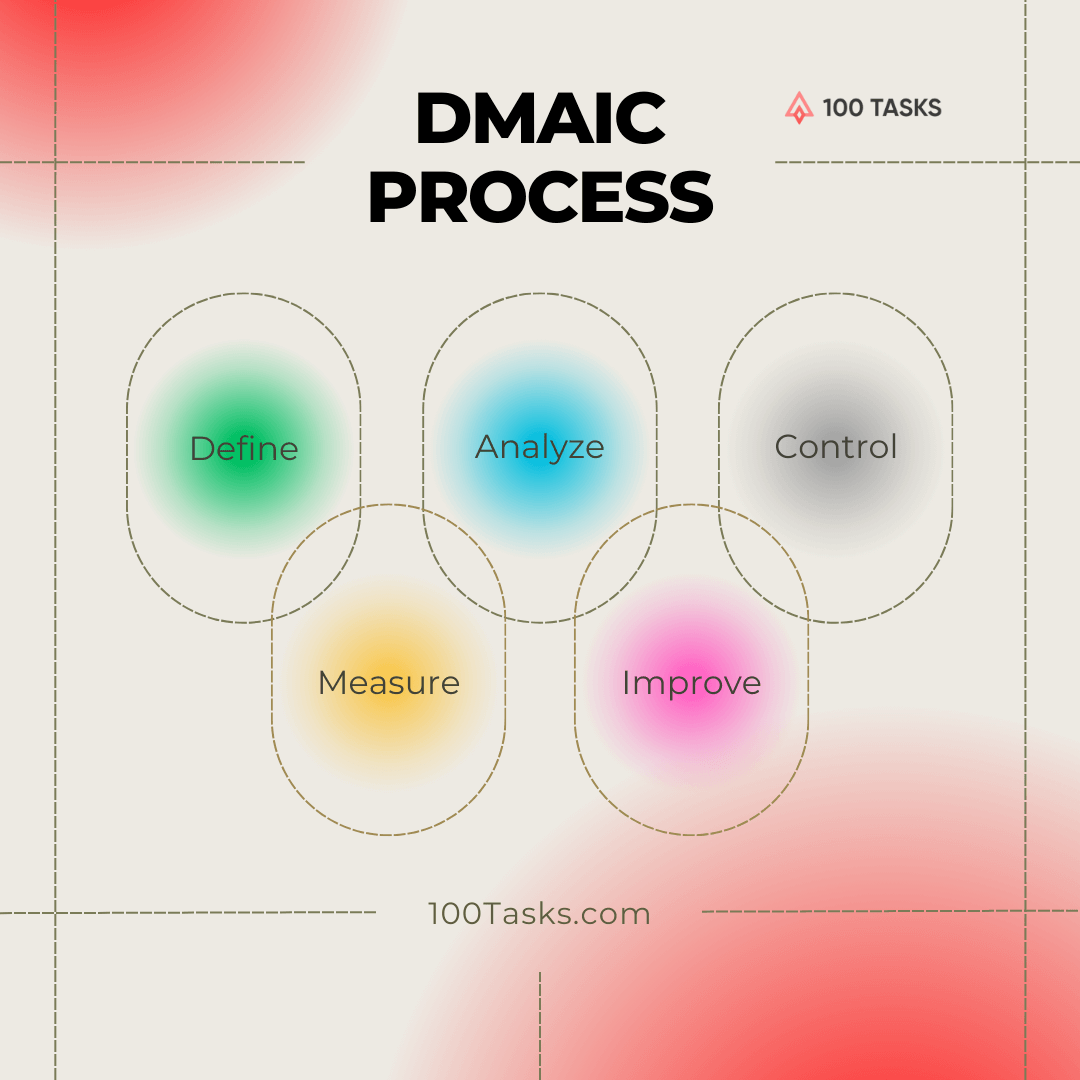
DMAIC stands for Define, Measure, Analyze, Improve, and Control. It is a structured, data-driven method for improving an existing process that is not meeting customer needs or performance requirements.
The American Society for Quality describes DMAIC as a problem-solving approach used in Six Sigma, Lean, and other improvement work. NIST’s Lean, ISO, and Six Sigma overview similarly distinguishes DMAIC for improving existing processes from design methods used to create new ones.
When to Use DMAIC
DMAIC fits when:
- a repeatable process already exists;
- performance is measurably below a requirement or customer need;
- the cause is not yet established;
- the problem is important enough to justify structured analysis;
- a process owner can sustain the eventual change.
Do not force DMAIC onto every decision. If there is no existing process, a design method may fit better. If the root cause and remedy are obvious, a smaller corrective action may be sufficient. If leadership has not agreed on the problem or metric, the project is not ready to skip into analysis.
DMAIC at a Glance
| Phase | Main question | Core output |
|---|---|---|
| Define | What problem matters, to whom, and within what scope? | Approved charter and customer requirement |
| Measure | How does the process work and perform now? | Valid process map, measurement plan, and baseline |
| Analyze | Which causes are supported by evidence? | Verified root causes |
| Improve | Which change addresses those causes? | Tested solution and implementation plan |
| Control | How will the gain be sustained and detected if it slips? | Process standard, owner, monitoring, and response plan |
Define: Set the Boundary
Create a project charter with:
- problem statement based on current performance;
- customer or stakeholder requirement;
- scope and explicit exclusions;
- primary outcome metric and relevant guardrails;
- process owner, team, and decision rights;
- target condition and timeline;
- known constraints and risks.
Avoid embedding a preferred solution in the problem statement. “Implement automation” is not a problem. “Qualified requests wait too long between intake and first review” leaves room to discover the cause.
Measure: Establish Trustworthy Current State
Map how the work actually happens, including rework, queues, handoffs, and exceptions. Then define the metric precisely: unit, start event, stop event, population, data source, and owner.
Check whether the measurement system is reliable enough for the decision. A dashboard can be precise and still measure the wrong event. The comparison of process maps and value-stream maps helps choose the right view.
The Measure phase should end with a baseline and a list of plausible factors, not a conclusion based on anecdotes.
Analyze: Verify Causes
Stratify the data by relevant conditions such as request type, channel, customer segment, handoff, shift, or product version. Use process observation, cause-and-effect analysis, Pareto charts, scatter plots, or other appropriate methods.
Distinguish correlation from cause. A credible root cause should explain the pattern and survive a test against the process. “People need training” is not a sufficient conclusion until the analysis shows which behavior, in which step, creates the defect.
Improve: Test the Cause-and-Effect Logic
Generate several countermeasures for the verified causes. Evaluate customer impact, feasibility, risk, cost, and unintended consequences. Pilot the smallest change that can expose whether the proposed mechanism works.
Compare performance with the baseline and guardrails. A faster process that increases errors, privacy risk, or customer effort is not an improvement.
Control: Make the New Process Operable
Document:
- the standard process and owner;
- the metric, collection method, and review cadence;
- acceptable operating boundaries;
- who responds when performance moves outside them;
- training and access requirements;
- an audit or confirmation date;
- how future changes will be approved.
Control is not “watch the dashboard.” It is a clear reaction plan that prevents the process from drifting back unnoticed.
Worked Example: Slow Support Triage
Consider an illustrative subscription business where customers report that urgent support requests wait too long for the right specialist. This is a method example, not a claimed company result.
Define
The team limits scope to the period from request submission to correct specialist assignment. The customer requirement is timely, accurate routing. Resolution time remains a guardrail so the project does not merely move the delay downstream.
Measure
The team maps intake, automated tagging, manual review, reassignment, and specialist acceptance. It defines the start and stop events and reviews a representative period of request records.
Analyze
Data is stratified by request category and initial tag. The team finds that a small set of ambiguous categories produces repeated reassignment. Observation shows that the intake form lacks the information reviewers use to distinguish those categories.
Improve
The team pilots two clearer intake questions and a routing rule for those categories. It checks assignment time, reassignment, abandonment, and total resolution rather than celebrating speed alone.
Control
The support owner documents the questions and routing rule, reviews exceptions on a fixed cadence, and defines what pattern triggers a rule review. New categories are not added without checking the same evidence.
The example works because every change traces to a measured cause.
DMAIC’s Relationship to Six Sigma Tools
DMAIC is the project spine. Tools are selected inside the phases based on the question and data. A Pareto chart may help prioritize categories in Measure or Analyze; a fishbone diagram can organize cause hypotheses; a control chart may support Control.
The guide to 10 Six Sigma tools is the tools spoke for this pillar. For the broader distinction between waste-focused and variation-focused improvement, read Lean versus Six Sigma.
Common DMAIC Failure Modes
- defining a solution instead of a problem;
- measuring what is available rather than what matters;
- accepting a brainstormed cause without verification;
- rolling out an untested fix across the whole process;
- ignoring customer or risk guardrails;
- ending the project without an owner and reaction plan.
DMAIC creates value when it changes how a process performs, not when it produces five folders of slides.
Martin Bell
Founder of 100 Tasks. Martin Bell has launched or supported 120+ startups and turned Rocket Internet venture-building discipline into a step-by-step system used by 25,000+ founders and startups.