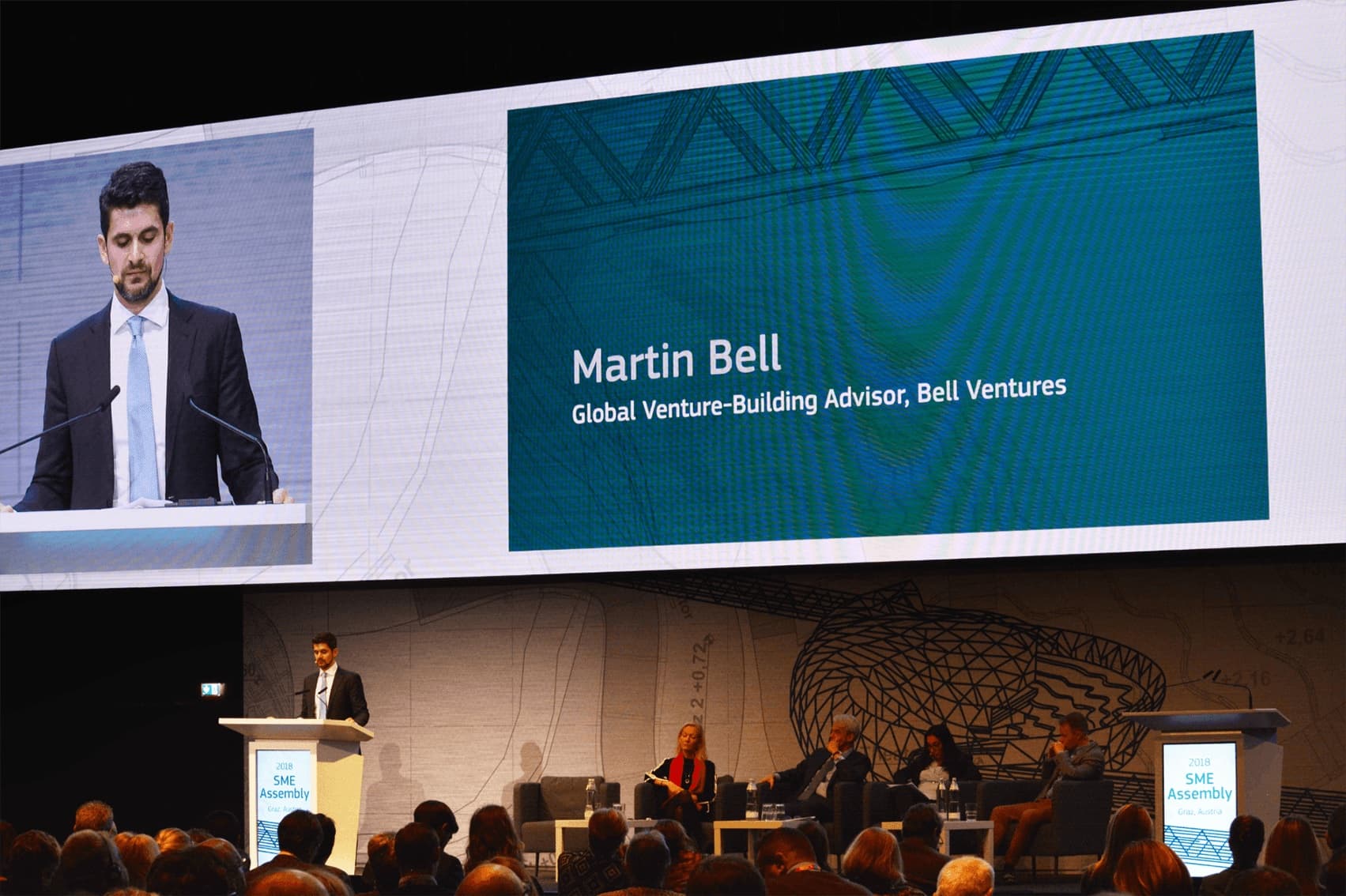
 Martin Bell10 Min ReadPublished Jul 9, 2026Updated Jul 21, 2026
10 Business Pitch Examples for New Founders (2026)
Ten complete, annotated pitch scripts for customers, pilots, demos, investors, partners, recruits, internal sponsors, and programs.
A business pitch is not one speech shortened or stretched for every audience. A prospective customer, pilot sponsor, investor, partner, candidate, and grant reviewer are making different decisions. They need different evidence and a different next step.
The ten examples below are illustrative scripts. Replace every bracketed statement with facts you can support, remove anything that does not apply, and say the pitch aloud before using it. A useful pitch makes one decision easier; it does not try to explain the entire company.
For the underlying framework and preparation process, use the main business pitch guide. This page focuses on what the words can sound like in distinct situations.
The Seven Building Blocks
Most pitches draw from these blocks:
- audience or context
- costly problem
- current alternative
- specific approach
- relevant evidence
- explicit ask
- immediate next step
Do not force all seven into every script. A 20-second introduction may need only audience, problem, approach, and conversational next step. An investor pitch needs market insight, traction, team, and use of funds as well.
1. The 20-Second Networking Pitch
Situation: Someone asks, “What are you building?” You want a relevant conversation, not a monologue.
We help independent implementation consultants stop projects from stalling while they wait for client inputs. Instead of chasing files and approvals through email, they use one dependency view that shows what is missing, who owns it, and what the delay affects. We are testing it with teams that run several client launches at once. Do you work with anyone who manages that kind of implementation?
Why it works: It names the customer, workflow, current friction, and product behavior in plain language. The final question helps the listener connect the pitch to experience.
What to replace: Use your real customer and observed problem. Do not say “testing” if you have no active test; say “researching” or “building” accurately.
2. The Customer Problem Pitch
Situation: A buyer has described the workflow. You need to confirm fit and propose a next step.
You said every new client launch depends on about a dozen items from three people, and your team currently tracks them in email and a shared sheet. The hard part is not listing the tasks; it is seeing which missing input will block next week's work. Our first version turns those dependencies into one customer-facing checklist and sends the project owner a reviewed blocker summary. If we used one upcoming launch, would a two-week setup and test give you enough evidence to decide whether the workflow is useful?
Why it works: The opening comes from the buyer's words. The product claim stays narrow, and the ask is a bounded evaluation rather than “Would you buy our platform?”
Proof to add: Insert a relevant result only when the scope and customer are comparable. A famous logo does not repair a weak problem match.
3. The Paid Pilot Pitch
Situation: A business buyer believes the problem is real but needs a low-risk commercial test.
We propose a four-week pilot for one implementation team and up to [agreed number] active projects. In week one, we map the current intake and configure the dependency checklist. In weeks two and three, your team runs real launches while we review missing inputs and exceptions. In week four, we compare the agreed baseline with completion, blocker visibility, and team usage. The pilot costs [price], requires one project owner and a weekly 30-minute review, and ends with a documented continue, change, or stop decision. If that scope matches your evaluation process, the next step is a working session with the project owner.
Why it works: Scope, responsibilities, evaluation, price, and finish line are visible. A paid pilot is not discounted consulting without a decision rule.
What to prepare: A one-page mutual action plan, data/access requirements, success criteria, and what happens to pilot data afterward.
4. The Product Demo Opening
Situation: You have 20 minutes with a qualified buyer. The pitch should frame the demonstration around their job.
Before I show the product, I want to confirm the workflow we are testing today. A project starts, several client stakeholders owe inputs, and your delivery lead needs to know which missing item threatens the next milestone. I will show three things: how the client sees the request, how the lead sees the blocker, and how the decision is recorded. I will not cover reporting or portfolio planning unless those become relevant. At the end, I would like you to tell me where this would fail in your current process.
Why it works: It defines the user story and limits the tour. Asking where the flow fails produces stronger evidence than asking whether the buyer “likes” it.
What to avoid: Do not respond to every objection by opening another feature. Record missing requirements separately.
5. The Investor Narrative Pitch
Situation: A pre-seed investor needs to understand the insight, wedge, evidence, and round purpose.
Small implementation firms do not usually lose projects because they lack a task list. They lose time because client dependencies arrive late and nobody can see which missing input blocks revenue-producing work. We learned this through [number and type of interviews or paid pilots], where teams described the same email-and-spreadsheet workaround. We are starting with client-input tracking for [narrow segment], then expanding only if usage proves we own the implementation handoff. Today, [state current evidence without inflation]. We are raising [round] to prove [specific milestones], primarily through [product, distribution, or team use]. We would like a second meeting to review the customer evidence, product usage, and milestone model.
Why it works: The pitch separates insight, wedge, traction, expansion logic, and use of funds. It does not use a giant market slide as a substitute for a credible starting point.
Evidence to prepare: Use the metrics appropriate to your stage. This guide to pre-seed startup metrics can help you choose evidence without pretending early signals are mature traction.
6. The Partnership Pitch
Situation: A consultancy or software provider reaches the same customer before you do.
Your team helps implementation consultancies standardize delivery, while we focus on the client-input bottleneck that appears after a project is sold. Rather than propose a broad partnership, I suggest we review five anonymized implementation plans together. If we find a repeated dependency problem, we can create one joint checklist and test it with a customer who opts in. Your team keeps ownership of the advisory relationship; we handle the workflow test. After one cycle, we decide whether a referral path is useful.
Why it works: It proposes a small piece of work that can reveal mutual value. Ownership and customer consent are explicit.
What to avoid: Do not promise access to an audience you do not have or ask a partner to recommend an untested product.
7. The First-Hire Recruiting Pitch
Situation: A strong candidate needs an honest account of the company, role, risk, and near-term work.
We are building a dependency workflow for small implementation teams. The problem is validated at [current evidence level], but we still need to prove [main unresolved risk]. The next six months are not about scaling a finished product. They are about working with early customers, making the core flow reliable, and deciding which integrations matter. We need a [role] who wants direct customer context and can own [specific outcomes]. The constraints are [team, funding, compensation, location, or uncertainty stated accurately]. If that stage interests you, the next conversation is a working review of one real product problem and the role scorecard.
Why it works: It sells the work and responsibility without hiding uncertainty. Good candidates can opt in to the actual stage rather than a polished future story.
What to prepare: Role outcomes, decision rights, compensation details, current runway information appropriate to share, and a fair assessment process.
8. The Internal Sponsor Pitch
Situation: An employee wants approval to test a new workflow inside an existing company.
Our launch team spends time every week asking which client inputs are missing, but we do not have a reliable baseline yet. I propose a two-week internal test on one project. We will record missing inputs, owner, delay, and time spent coordinating; then use a shared dependency view for the next project phase. The test needs one delivery lead and no integration. It will not change the customer contract or automate reminders. At the end, we will compare coordination time, missed dependencies, and team feedback, then recommend stop, revise, or expand.
Why it works: The pitch does not claim savings before measuring them. It reduces approval risk through scope, ownership, and a reversible test.
What to avoid: Do not present a vendor purchase as an experiment if procurement, security, or data access already makes it a larger decision.
9. The Accelerator Application Pitch
Situation: A program is evaluating founder insight, progress, coachability, and fit.
We are building for small implementation firms whose launches stall while client inputs remain scattered across email and spreadsheets. After [research or customer evidence], our current insight is that blocker visibility matters more than another project plan. We tested that by [manual or product test] and learned [specific result or contradiction]. The next risk is [unresolved question]. This program is relevant because [specific mentor, market access, or operating support], and during the program we plan to prove [measurable milestone]. Our team brings [relevant experience stated factually], and we are looking for help with [specific gap].
Why it works: It shows what the team learned, what remains uncertain, and why this particular program changes the next experiment.
What to avoid: Do not paste an investor pitch into every application. Answer the selection criteria directly.
10. The Grant or Innovation Program Pitch
Situation: A funder evaluates eligibility, project scope, feasibility, impact, budget, and reporting—not venture excitement alone.
We are requesting [amount or resource] to run a defined project with [eligible beneficiary or participant group]. The project will test whether a shared dependency workflow improves [specific observable outcome] across [scope and period]. Work includes [activities], led by [qualified owners], with milestones at [stages]. The budget covers [eligible cost categories], and progress will be measured through [methods]. The output will be [deliverable], while [items outside scope] are explicitly excluded. If selected, we will complete the required reporting and use the results to decide whether the approach should continue.
Why it works: It maps the pitch to a funded project and measurable outcome. It does not assume a grant is “free startup money” or that investor language proves public benefit.
What to verify: Use the specific program's current rules and obtain qualified advice where required. Never invent eligibility, matching funds, impact, or cost treatment.
Edit the Pitch Against the Decision
Before using any example, write four words at the top of the page:
- Audience: Who is listening?
- Decision: What are they deciding?
- Proof: What evidence matters to that decision?
- Ask: What should happen next?
Then cut any sentence that does not help. New founders often add company history, feature lists, and market adjectives because the evidence feels incomplete. More language does not create more proof.
If fundraising is the goal, prepare for the process beyond the pitch. The guides to raising seed funding and startup due diligence explain the next layers of evidence. If the company is still at the starting line, use the first-time founder checklist to keep the pitch connected to the work that must actually be completed.
One audience, one decision, one honest body of proof, and one clear next step: that is a business pitch people can act on.
Martin Bell
Founder of 100 Tasks. Martin Bell has launched or supported 120+ startups and turned Rocket Internet venture-building discipline into a step-by-step system used by 25,000+ founders and startups.