 Martin Bell12 Min ReadPublished Jul 9, 2026Updated Jul 21, 2026
How to Validate a Startup Idea With No Audience (2026)
A 2026 validation process for founders starting from zero reach, using direct customer learning instead of audience size.
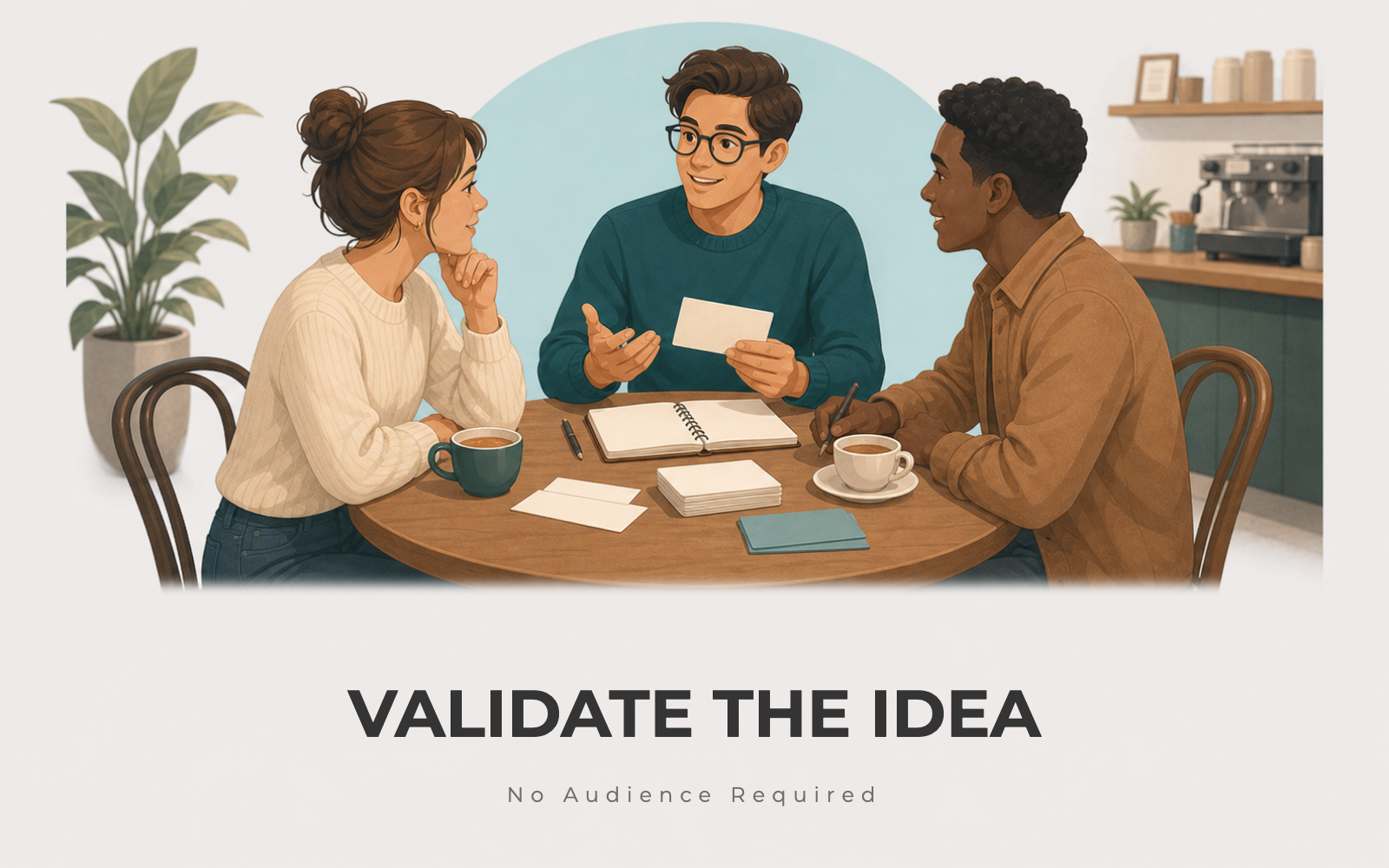
You do not need followers to validate a startup idea. You need a specific customer you can find, a painful situation you can observe, and a test that asks for more than an opinion.
An audience helps distribute an offer. It does not make the offer true. Starting without one can even improve your research because you must leave your own feed, find actual buyers, and learn the language they use when the problem occurs.
This guide shows how to validate a startup idea from zero reach: where to find interviewees, what to say, how to test a manual offer, and how to decide what the evidence means.
Define a customer you can actually locate
“Small businesses” is not a usable segment. Neither is “busy parents” or “creators.” You should be able to build a list of 25 plausible people without guessing.
Use this sentence:
I want to learn from [role or situation] who recently [observable event] and currently use [alternative or workaround] to achieve [important outcome].
Examples:
- Operations managers at home-service companies that added a second location and still schedule crews in spreadsheets.
- Independent accountants who prepare monthly client reports by copying data from three systems.
- Parents who arranged recurring transport for an older relative in the past three months.
The event matters. It gives you a reason to believe the problem is current and something concrete to discuss.
If you cannot name a reachable group, return to startup ideas that fit your existing experience. Reach is part of idea quality, not an afterthought.
Build a 30-person research list without an audience
Use places where the work leaves a trace. Do not scrape or spam; collect only the information you need for relevant, respectful outreach.
Search the market’s public surfaces
- Company team and job pages reveal roles, tools, and active priorities.
- Professional directories and association member lists reveal specialists.
- Software review sites reveal complaints about current alternatives.
- Marketplaces reveal service providers already paid to solve the problem.
- Public community discussions reveal the words people use, but follow each community’s contact rules.
- Conference agendas, podcasts, and webinars reveal practitioners who speak about the workflow.
Ask for introductions without “having a network”
You may not know target buyers, but you probably know people who know one. Send a narrow request:
I’m researching how multi-location cleaning companies schedule last-minute crew changes. I’m not selling anything. Do you know one operations manager who has dealt with this recently and might give me 20 minutes?
Specific requests are easier to route than “Do you know any entrepreneurs?”
Buy learning carefully
For hard-to-reach professional segments, a small research honorarium can be appropriate. Be transparent that it is research, not a testimonial. Payment may improve access, but it does not turn positive comments into purchase evidence.
Track source, role, relevance signal, contact date, reply, interview, and next step in one sheet. Your first goal is not a massive list. It is enough variation to learn whether the pattern exists beyond one friendly respondent.
Use outreach that earns a reply
Your message should make four things clear: why this person, what topic, how much time, and that you are not disguising a pitch.
Cold research message
Subject: Question about [specific workflow]
Hi [Name] — I noticed [relevant event, role, or public detail]. I’m researching how [specific group] handle [specific situation]. I’m not selling a product; I’m trying to understand the current process before building anything. Would you be open to a 20-minute call next week? I’m especially interested in the last time [event] happened.
Follow-up after five to seven days
Hi [Name] — one quick follow-up in case this is relevant. I’m still looking for people who recently [event]. If that is not part of your work, no reply needed. If someone else owns it, a pointer would help.
Stop after a small number of considerate attempts. No response can mean poor timing, weak targeting, an unimportant problem, or an unclear message. Change one variable at a time before drawing a conclusion.
If outreach itself is the larger problem, use the sourcing and follow-up system in how to find your first 10 customers.
Run interviews about behavior, not your concept
A useful interview reconstructs one recent episode. This is the core of practical customer development.
Ask:
- “Tell me about the last time this happened.”
- “What triggered it?”
- “What did you do first, then what?”
- “Which tools or people were involved?”
- “Where did the process slow down or fail?”
- “What happened because of that?”
- “What have you already tried to change?”
- “Who owns the budget or decision?”
Avoid leading questions such as “Would automation save you time?” and speculative questions such as “Would you pay $29?” People are generous with imagined future behavior.
Capture exact phrases, the current workaround, frequency, consequence, and buying process. Separate what the person did from what they say they might do.
After five conversations, compare notes. After each additional conversation, record whether it revealed a new workflow or repeated an existing pattern. Repetition is useful; perfect agreement is not required.
Turn what you heard into a falsifiable claim
Summarize the idea as:
When [trigger] happens, [customer] struggles to [job], causing [consequence]. They currently use [alternative]. We believe they will [specific commitment] for a solution that [narrow outcome].
List the riskiest assumption. It is usually one of these:
- The problem happens often enough.
- The consequence is important enough.
- The buyer can be reached.
- The user will change behavior.
- Someone has authority and budget.
- You can deliver the outcome reliably.
Test that assumption first. Do not build a complete product to answer a reachability question.
Test a manual offer before software
Create the smallest paid or commitment-based version of the outcome. This is often a service, audit, workshop, spreadsheet, prototype, or concierge workflow.
For example, suppose interviewees struggle to compare supplier quotes with inconsistent line items. Do not begin with procurement software. Offer to normalize and compare one real set of quotes within 48 hours, then deliver the result in a spreadsheet and a short call.
The test should specify:
- One customer type.
- One input the customer must provide.
- One completed result.
- A deadline.
- A price or meaningful commitment.
- What is explicitly out of scope.
The customer’s action matters more than your production quality. Sharing sensitive-but-appropriate workflow data, introducing the budget owner, signing a pilot agreement, paying a deposit, or returning for a second use are stronger signals than “This is interesting.”
Browse minimum viable product examples for ways to deliver a complete result without building every feature.
Use an evidence ladder
Not all validation signals deserve equal weight.
| Signal | What it may show | What it does not prove |
|---|---|---|
| Likes, poll votes, compliments | Topic resonance | Purchase intent |
| Interview agreement | Recognized problem | Behavior change |
| Detailed workflow and workaround | Lived problem | Budget |
| Introduction to a decision-maker | Internal relevance | A deal |
| Real data or time committed | Willingness to participate | Repeat use |
| Signed pilot or payment | Buying intent | Retention or scalable acquisition |
| Repeat use or renewal | Ongoing value | Large market size |
Set decision rules before the test. They are not universal startup benchmarks; they are safeguards against moving the goalposts.
For one two-week test, you might decide:
- Continue if at least three relevant people complete the manual workflow and one makes a commercial commitment.
- Revise the segment if the pain repeats but the same person never owns the decision.
- Revise the problem if conversations produce different triggers and workarounds.
- Stop this version if qualified prospects repeatedly decline both the conversation and the manual test after you have tested clearer targeting and messaging.
Choose numbers that fit your sales motion and sample. Enterprise buyers and consumer users produce different evidence at different speeds.
A 10-day zero-audience validation sprint
Days 1–2: Define and source
Write the segment sentence, choose one risky assumption, and collect 30 relevant names from three sources. Record why each person plausibly fits.
Days 3–5: Contact and interview
Send ten tailored messages per day. Hold interviews as replies arrive. Update the script when a question produces vague answers.
Day 6: Synthesize
Group evidence by trigger, current process, consequence, and buyer. Write one falsifiable problem claim. Do not average away meaningful segment differences.
Days 7–8: Make the manual offer
Invite the most relevant interviewees to complete one real workflow. State price, scope, timeline, and what they must contribute.
Days 9–10: Deliver and decide
Deliver the outcome, observe use, and ask what happens next. Review the prewritten decision rules. Continue, narrow, change the offer, or stop.
Ten days will not prove an entire company. It can prevent months spent building on an assumption nobody has tested.
Diagnose weak results correctly
People do not reply
Check list quality before changing the idea. Is there a real relevance signal for each person? Then check the message: is the topic narrow, the request small, and the reason for contacting them credible?
People talk, but the stories are vague
Ask about the last occurrence, not the general topic. If they cannot recall one, the problem may be infrequent or you may have the wrong participant.
The problem is real, but nobody commits
Investigate consequence, authority, and current alternatives. A painful user may not be the buyer. Or the workaround may be good enough.
One customer wants everything
Treat custom requests as clues, not a roadmap. Look for the same trigger and outcome across several relevant customers before broadening the offer.
Friends love it
Support is kind but not independent evidence. Keep friendly feedback in a separate column from target-customer behavior.
Keep a validation record
Use one row per evidence event:
| Date | Person and segment | Recent trigger | Current workaround | Consequence | Commitment | Contradiction | Next test |
|---|
At the end of each week, write three short statements:
- We learned: a pattern supported by observed behavior.
- We still assume: an important claim without enough evidence.
- Next we will test: one action that could change the decision.
This keeps customer validation cumulative. Without a record, founders remember enthusiasm and forget contradictions.
What validation should produce
Good validation does not produce certainty. It produces a sharper bet:
- A customer definition you can source.
- A recent, consequential problem.
- A known workaround and buying path.
- A narrow outcome you can deliver manually.
- At least one meaningful commitment.
- A next assumption worth testing.
Your lack of an audience is not the obstacle. An undefined customer and a low-commitment test are. Find people through the work they already do, ask about real events, earn a concrete commitment, and let the evidence decide what you build next.
Martin Bell
Founder of 100 Tasks. Martin Bell has launched or supported 120+ startups and turned Rocket Internet venture-building discipline into a step-by-step system used by 25,000+ founders and startups.