 Martin Bell11 Min ReadPublished Jul 9, 2026Updated Jul 21, 2026
How to Turn a Service Business Into Software (2026)
A 2026 guide to turning repeated service delivery into software only after the workflow, buyer, and value are proven.
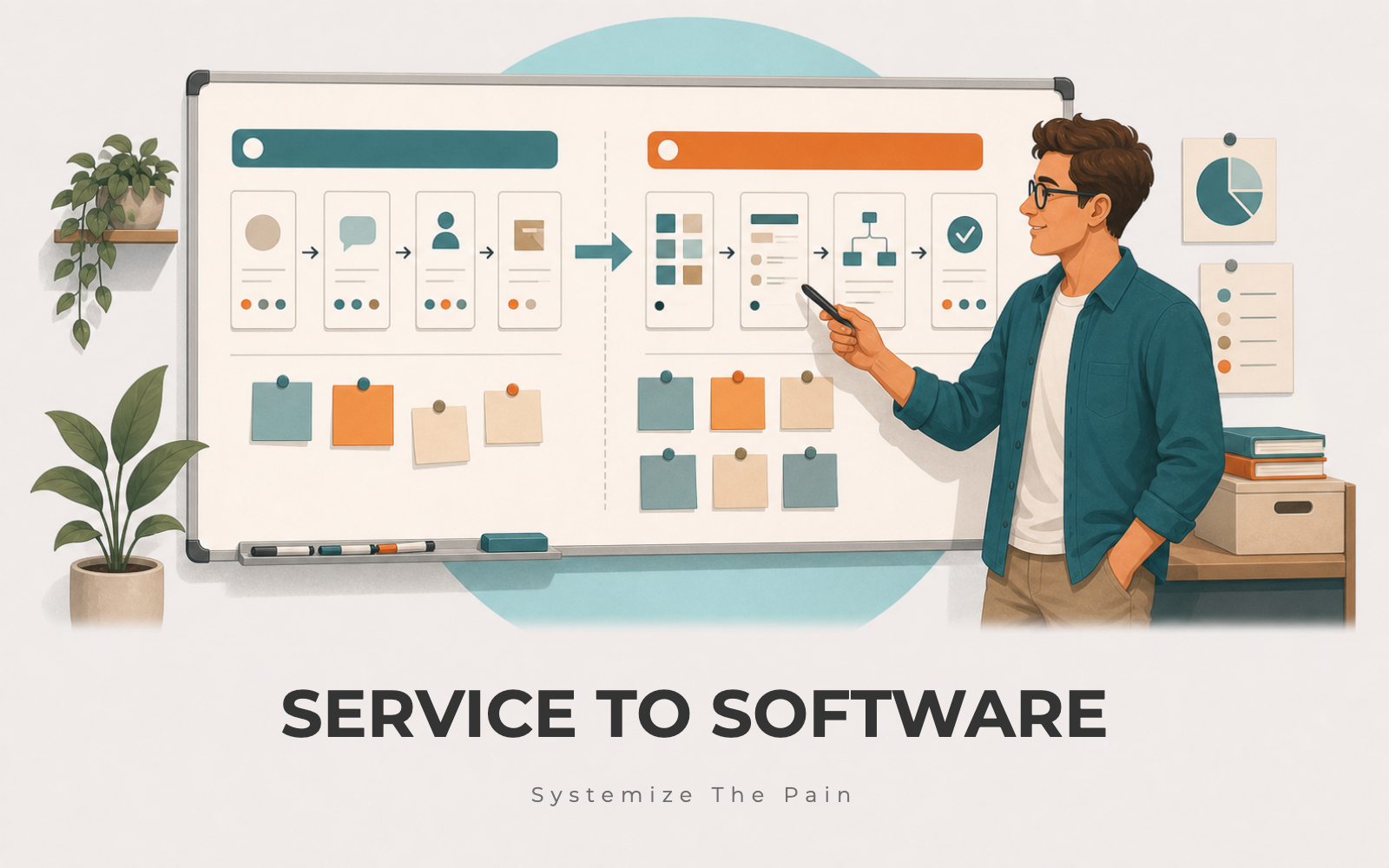
A service business can reveal a strong software opportunity because you already see the work up close. You know which inputs arrive late, which spreadsheet breaks every week, and which outcome clients value enough to buy.
That does not mean the entire service should become an app.
The safer route is to find one repeated, expensive workflow; prove that customers want to perform it differently; and automate only the smallest useful slice. Software is a delivery model, not evidence of demand.
This guide gives you a practical service-to-software process, including a workflow map, a product-wedge scorecard, an illustrative example, and the metrics that tell you when to build more.
First decide whether software is the right destination
Service founders often reach for software for one of four reasons: delivery takes too much founder time, clients want self-service, the same mistake keeps recurring, or recurring revenue sounds more attractive than project revenue. Only the first three point to a customer workflow. The fourth is merely a business-model preference.
Before writing code, compare three possible destinations:
| Destination | Best when | What the customer buys |
|---|---|---|
| Better-run service | Judgment and trust create most of the value | An outcome delivered for them |
| Productized service | The scope is repeatable but human work still matters | A fixed package with a clear process |
| Software product | Users can complete a frequent workflow with little expert intervention | Ongoing access to a tool |
If customers need you to diagnose a different problem every time, improve the service. If the work is consistent but still requires human judgment, begin with a productized service. Software becomes attractive when the same user encounters the same structured job often enough to learn a new tool.
Map the service before choosing a feature
Choose one service package and reconstruct the last five deliveries. Do not document the ideal process. Document what actually happened.
Create one row for every meaningful step:
| Step | Trigger | Input | Person doing it | Minutes | Failure mode | Customer-visible value |
|---|---|---|---|---|---|---|
| Collect data | Monday morning | Three client exports | Analyst | 35 | Wrong date range | Low |
| Find exceptions | Data received | Normalized spreadsheet | Analyst | 50 | Issue missed | High |
| Draft recommendation | Exceptions tagged | Notes and context | Strategist | 45 | Advice too generic | Very high |
| Send report | Review complete | Account manager | 15 | Client cannot act | Medium |
Then mark each step as one of four types:
- Transfer: moving or reformatting information.
- Rule: applying a stable condition or calculation.
- Judgment: interpreting ambiguity with expertise.
- Relationship: creating confidence, alignment, or accountability.
Transfer and rule steps are usually easier to automate. Judgment and relationship steps may remain a service layer for a long time. The goal is not maximum automation; it is a better unit of value.
Find the smallest useful product wedge
A product wedge is one narrow job that produces a complete result. “A dashboard” is not a wedge. “Alert an operations manager when a weekly export contains a billing exception, then show the source row” is.
Score possible wedges from 1 to 5 on these questions:
- Frequency: How often does the user perform or encounter the job?
- Pain: What does a failure cost in money, time, risk, or reputation?
- Consistency: Are the inputs and rules similar across customers?
- Autonomy: Can the user get a result without calling you?
- Reach: Can you name and contact ten likely users?
- Proof: Have customers already paid you to solve this problem manually?
Reject any candidate with a 1 on consistency or autonomy, even if the total score looks high. It is probably a bespoke service wearing a software label.
Strong wedges usually have one user, one trigger, one core action, and one visible result. That is narrower than many micro-SaaS ideas, which is useful: a wedge earns the right to expand.
Validate the new behavior, not just the old pain
Existing service revenue proves that customers want an outcome. It does not prove they want to log in, connect data, configure rules, or do part of the work themselves.
Interview current customers around a recent event:
- “Walk me through the last time this happened.”
- “What did you do before sending it to us?”
- “Who else needed to approve or inspect the result?”
- “Which part would you want to control yourself?”
- “What would prevent you from using this without us?”
Avoid “Would you use software that…?” Hypothetical agreement is cheap. A stronger customer-validation test asks customers to do something: share a real input, attend a workflow session, connect a test account, pay for a pilot, or use a manual version twice.
Write a testable product claim:
For [specific user] who currently [observable workflow], this product will [complete result] within [time or effort boundary], without [current bottleneck].
For example: “For agency finance leads who reconcile contractor invoices every Friday, this product will identify mismatches in a CSV within ten minutes, without a manual row-by-row review.”
Build the product in four evidence stages
Stage 1: Deliver it manually behind a simple interface
Give customers a form, shared folder, or lightweight portal. Perform the hard work yourself. Measure whether they provide the inputs, understand the result, and return the following week.
This is a concierge test. Its purpose is learning, not pretending the operation is automated.
Stage 2: Automate the repeated rule
Automate one step that is stable across multiple deliveries. Keep review and exceptions manual. If normalizing three export formats consumes most of the time, build that before a polished account area.
The best minimum viable product examples produce a complete outcome with deliberately limited scope.
Stage 3: Give the user control
Let a small group trigger the workflow, correct inputs, and inspect results. Watch them use it. Every question they ask reveals missing context, unclear language, or a trust boundary.
At this stage, distinguish an MVP from a prototype: a prototype explores interaction, while an MVP must deliver enough real value to support real usage and a buying decision.
Stage 4: Separate service and software offers
Price and describe them separately. A useful early ladder is:
- Software: customer operates the workflow.
- Software plus review: your team checks exceptions.
- Managed service: your team owns the outcome.
This prevents high-touch promises from hiding weak product adoption. It also lets customers choose how much responsibility they want.
An illustrative service-to-software example
Imagine a two-person consultancy that creates weekly marketplace performance reports for independent brands.
Its initial service includes exporting data, cleaning product names, finding abnormal conversion changes, writing recommendations, and presenting them. The founders first assume the full report should become software.
The workflow map changes the plan. Export cleanup is repetitive but low-value. Recommendations require context. The urgent, frequent job is detecting which products need attention before the weekly meeting.
The founders test a narrow wedge: a client uploads one export and receives a list of products whose conversion rate moved beyond a customer-set range. For four weeks, the founders calculate and review the list manually. Three clients repeatedly upload the file; two ask whether a teammate can access the result; one pays for a pilot.
They automate parsing and comparison, but keep recommendations human. The product is not yet “analytics software.” It is an exception-finding workflow with evidence of repeated use.
This example is illustrative, not a benchmark. Your proof should come from your own customers, frequency, and economics.
Track product evidence separately from service success
Create a small weekly dashboard:
| Question | Early metric |
|---|---|
| Does the problem recur? | Eligible workflow events per customer |
| Do users start without prompting? | Self-initiated runs / eligible events |
| Do they reach value? | Completed results / started runs |
| Do they return? | Customers completing the workflow again in the next relevant period |
| Does the product save delivery effort? | Median human minutes per completed result |
| Will anyone buy this mode? | Paid pilots, renewals, or signed orders |
Do not invent universal pass marks. Before each pilot, write down what result would make you continue, revise, or stop. A monthly compliance workflow should not be judged by daily usage, and a five-customer design partnership should not be compared with a self-serve funnel.
Watch for a dangerous pattern: service revenue remains healthy while product usage stays dependent on reminders. That means customers may value your service but not the proposed product behavior.
Common service-to-software mistakes
Rebuilding the internal operating system
Your team may love a tool that coordinates delivery, but customers may not want it. Decide whether you are building internal leverage or a customer product. Both can be valuable; they are different investments.
Automating exceptions before the normal path
Complex edge cases make founders feel productive because they resemble “real software.” First make the common input produce a trusted result. Handle rare exceptions manually until their frequency justifies code.
Expanding to every customer request
Service clients are accustomed to asking for custom work. For each request, ask whether the same user, trigger, and outcome recur across the target segment. If not, price it as service work or decline it.
Underpricing the product to encourage adoption
A token price can attract polite experiments without commitment. Price the pilot against the recurring problem and the alternative cost, then make the scope small enough that you can support it well.
Removing the human layer too early
Human review is not failure. It is a learning surface. Remove it only when the workflow is predictable, users trust the output, and exceptions have known handling paths.
Your next five actions
- Reconstruct five recent service deliveries in a workflow table.
- Label transfer, rule, judgment, and relationship steps.
- Score three possible product wedges and choose one narrow result.
- Ask five customers to complete a real behavior-based pilot.
- Automate only the most repeated stable step, then measure independent reuse.
Turning a service business into software is not a single launch. It is a sequence of risk reductions: from paid outcome, to repeated workflow, to changed customer behavior, to reliable automation. Preserve the human work that creates trust, productize the work that repeats, and let evidence—not the appeal of SaaS—decide what becomes software.
Martin Bell
Founder of 100 Tasks. Martin Bell has launched or supported 120+ startups and turned Rocket Internet venture-building discipline into a step-by-step system used by 25,000+ founders and startups.