 Martin Bell11 Min ReadPublished Jul 21, 2026
How to Split Startup Equity Between Co-Founders (2026)
Split on future contribution and risk, not who had the idea. Use a shared scoring worksheet, treat four-year vesting as non-negotiable, and document it before it becomes a dispute.
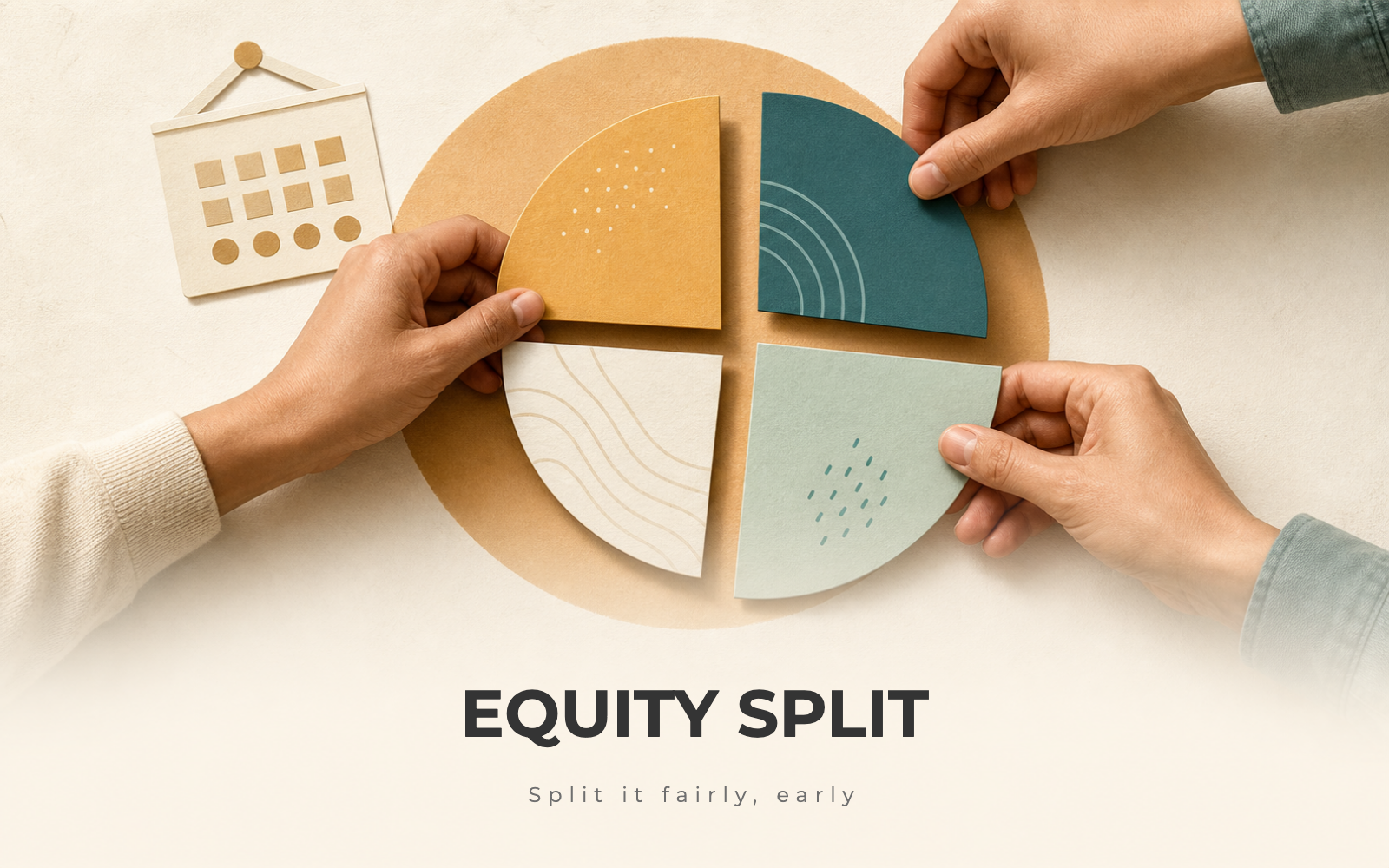
Most co-founder equity splits are decided in about ten minutes, usually 50/50, usually to avoid an uncomfortable conversation. That instinct feels fair and generous. It is also how a lot of founders create a much larger problem two years later, when one person has been full-time the whole way and the other drifted back to part-time — yet both still own half the company.
Equity is not a prize for having the idea. It is compensation for the years of full-time work, financial risk, and opportunity cost that turn an idea into a company. Whoever will carry more of that future load should generally own more of the future company. The split you can defend is the one that reflects contribution and risk going forward — not seniority, not friendship, not who typed the first line of code.
Here's the rule I give founders working through this: split on contribution and future risk, not a reflexive 50/50 that feels fair on day one and hurts on day 500. And vest everything — a four-year vest with a one-year cliff — so equity tracks who actually stays and builds, not who was in the room at the start.
This guide is the decision and the process: how to weigh the factors that actually matter, how to pressure-test a number with your co-founder in one structured conversation, why vesting is non-negotiable, and how to document all of it so a handshake never becomes a lawsuit. It is general information, not legal or tax advice — the real agreements belong with a startup lawyer.
What co-founder equity is actually paying for
Picture the total work your company will ever require as a pie. The idea, the pitch, the first prototype — everything that exists on day one — is a thin slice. The rest of the pie is the next four-plus years: building, selling, hiring, fundraising, support, and the hundred unglamorous decisions that compound into a business.
Equity divides ownership of that whole pie, most of which has not been created yet. So the real question is not "who deserves credit for where we are?" It is "who is going to do the work, carry the risk, and give up the most to get us where we're going?"
Three things dominate that answer:
- Future full-time work. A founder who quits their job and works on this for four years contributes vastly more than one who keeps a salary and helps on nights and weekends.
- Risk. Taking no salary, putting in savings, or turning down other offers is real, personal, downside risk. Equity is partly the reward for carrying it.
- Opportunity cost. The market salary a founder walks away from is a concrete number. Someone leaving a $180k role is investing more than someone leaving a $70k role, all else equal.
None of this is about the mechanics of shares, option pools, or how ownership gets diluted over time — for that groundwork, read the fundamentals of what startup equity actually is. This post is about the split itself: the human decision of who gets what, and why.
Why the reflexive 50/50 is a decision, not a default
A 50/50 split can be exactly right. Two founders leaving equal jobs to go full-time on an idea they shaped together, with complementary and equally critical skills, often should own the company equally.
The problem is not the number. The problem is reaching for it to skip the conversation. An even split chosen because "we're friends and I didn't want it to be weird" hasn't been tested against anything. When the workload turns out lopsided — and it usually does — there is no shared logic to point back to, only resentment.
There is also a governance trap in a pure 50/50 between two people: if you deadlock on a hard decision, nobody can break the tie. Many two-founder companies keep equal economics but still name one person as the final decision-maker, or issue a single tie-breaking share, precisely so a disagreement can't freeze the company.
So treat 50/50 as one possible outcome of the conversation, never as a way to avoid it. If an even split survives an honest look at contribution, risk, and role, adopt it with confidence. If it doesn't, you just avoided a slow-motion dispute.
The factors that should move the number
Before you argue about percentages, agree on what you are even weighing. These are the factors that legitimately shift a split, roughly in the order most early teams should weight them:
- Full-time commitment and opportunity cost. Who is all-in, from when, and what did they give up to be here? This usually deserves the most weight, because it is the largest and riskiest contribution.
- Role and skills criticality. Whose skills are hardest to replace over the next 24 months? The person who can build the product or win the first customers — in a company that has neither yet — is carrying critical-path work.
- Idea, early work, and IP. The original insight, and anything already built or legally protected, counts — but as one slice, not the whole pie. A validated prototype is worth far more than a sentence that starts with "what if."
- Capital contributed. Money a founder puts in is real risk and deserves recognition. Whether it buys equity, converts as a loan, or is handled separately is a question for your lawyer.
- Leadership and the final decision. Someone will be CEO and own the hardest calls, the investor relationships, and the accountability. That role often carries a modest premium.
- Network, customers, or distribution. Direct access to buyers or a channel that de-risks the whole company is a real asset, not a nice-to-have.
Notice what is not on the list: age, ego, who spoke first, or who "founded it" in spirit. Whose name is on the idea matters far less than who will carry it.
Score the split together: a co-founder worksheet
The fastest way to move from a tense negotiation to a shared decision is to make the reasoning visible. Sit down together, agree on a weight for each factor (the weights must sum to 100), then score each founder from 0 to 5 on every factor. Multiply weight by score, add up each column, and see what the numbers suggest.
Fill this in together, in one sitting:
| Factor | Weight (sum to 100) | Founder A score (0–5) | Founder B score (0–5) |
|---|---|---|---|
| Full-time commitment and opportunity cost | 25 | ||
| Role and skills criticality (next 24 months) | 25 | ||
| Idea, early work, and IP | 15 | ||
| Capital contributed | 15 | ||
| Leadership / final decision | 10 | ||
| Network, customers, or distribution | 10 |
The weights above are a sensible starting point, not a rule — adjust them to your situation as long as they still add to 100.
Here is the same worksheet filled in for a fictional two-person company. Maya left a senior engineering job to go full-time as CEO and took no salary; Devin had the original idea, put in $40k, and stayed part-time at his old job for the first six months:
| Factor | Weight | Maya (full-time CEO, no salary) | Devin (idea, $40k, part-time 6 mo) |
|---|---|---|---|
| Full-time commitment and opportunity cost | 25 | 5 | 2 |
| Role and skills criticality (next 24 months) | 25 | 5 | 3 |
| Idea, early work, and IP | 15 | 2 | 5 |
| Capital contributed | 15 | 1 | 4 |
| Leadership / final decision | 10 | 4 | 3 |
| Network, customers, or distribution | 10 | 3 | 3 |
| Weighted total | 365 | 320 |
The weighted totals come from multiplying each weight by that founder's score and adding down the column:
- Maya: (25×5) + (25×5) + (15×2) + (15×1) + (10×4) + (10×3) = 365
- Devin: (25×2) + (25×3) + (15×5) + (15×4) + (10×3) + (10×3) = 320
- Combined: 685
- Suggested split: Maya 365 ÷ 685 ≈ 53%, Devin ≈ 47%
The number is not the point. The point is that Maya and Devin can now see why it lands near 53/47 — full-time risk and critical skills on one side, the idea and early capital on the other. From here they might adopt exactly that, round to 55/45, or decide the idea and money deserve more weight and re-score. Any of those is fine, because it is now a reasoned decision they both understand and can repeat to an investor or a lawyer.
Use the worksheet as a conversation tool, not a verdict. If two founders score wildly differently on the same factor, you have just found the exact thing you need to talk about.
Vesting is what actually protects the split
Imagine you nail the split — a clean, fair 55/45 — and three months in, your co-founder takes another job and walks. Without vesting, they leave with 45% of your company forever. You now have a demoralizing, un-investable cap table and a near-stranger owning almost half of everything you build from here. That is called dead equity, and it kills companies.
Vesting solves it. Instead of owning your shares outright on day one, you earn them over time by staying and contributing; if you leave early, the company can buy back the unvested portion. The near-universal structure is a four-year vesting schedule with a one-year cliff, as Carta explains in its vesting primer:
- The one-year cliff. You earn nothing for the first 12 months. Leave before month 12 and you keep zero shares. This clears out early departures cleanly.
- After the cliff. 25% vests at the one-year mark, then the rest vests monthly — typically 1/48 of the total grant each month — over the remaining three years.
Vesting applies to founders, not just employees, and the start date is usually your incorporation or founder-agreement date. It is also what serious investors expect to see: unvested founder stock is often a precondition for a term sheet, because it is what keeps the whole team financially committed to staying.
One tax step usually accompanies founder restricted stock: an election under Section 83(b) of the tax code, which generally must be filed with the IRS within 30 days of the grant and cannot be filed late. The IRS provides Form 15620 for the Section 83(b) election. Whether it is right for you depends on your specific situation, so treat it as a question to ask your accountant or startup lawyer early — this is not tax advice, and the 30-day clock is unforgiving.
The single-founder case
If you are building alone right now, you can hold 100% and skip the split entirely — but do not skip the structure. If you expect to bring on a co-founder or key early hires, decide in advance how much equity you are willing to give and put your own founder stock on a vesting schedule from the start. It is far easier to grant equity from a clean, vested cap table than to claw it back from an early team member whose contribution did not last. Reserving an option pool for future hires is part of the same forward planning.
Put the split in writing (a handshake is not a cap table)
An agreement you never wrote down is not an agreement — it is a memory, and co-founders remember differently once money is involved. Every percentage, vesting schedule, and role needs to live in signed documents, not in a Slack thread.
At minimum, that means restricted stock purchase agreements (or founder stock agreements) spelling out each founder's shares, purchase price, and vesting terms, plus a cap table that records who owns what. You generally cannot issue stock with vesting as a sole proprietorship or a plain partnership — you need an entity built for it, usually a corporation, which is why your equity split and your choice of business structure are really one decision made at the same moment.
This is the point to involve a startup lawyer. Template documents exist and are fine as a reference, but the actual founder agreements, IP assignment, and stock paperwork should be reviewed by someone qualified in your jurisdiction. The few thousand dollars this costs at formation is trivial next to the cost of untangling a broken split later.
What later funding does to every founder's share
Your percentage today is not your percentage at exit. The moment you raise money, everyone's ownership shrinks — that is dilution, and it hits all founders proportionally. Owning 50% of a company that later raises several rounds might mean owning 20% by the time it matters, and that is a normal, healthy outcome if the company grew into it.
This is worth internalizing before you fight over five points at the start: whether you split 50/50 or 55/45 will usually move your final stake by less than a single funding round does. What you cannot easily fix later — an un-vested co-founder, or an undocumented handshake — matters far more than the last five percentage points of the initial split.
Early money often arrives through instruments that don't set a price immediately but convert into equity at your next priced round: the convertible note and the SAFE, including the post-money SAFE that Y Combinator introduced and popularized. Both dilute founders when they convert, which is exactly why your cap table has to be clean and documented before you raise. When you reach that stage, the walkthrough for raising a seed round covers the process itself.
Have the structured conversation this week
Founder equity goes wrong when it is decided fast, split evenly to avoid friction, sealed with a handshake, and never written down. It goes right when it is a deliberate decision you can both defend and a document you both signed.
Here is the concrete next step. Block ninety minutes with your co-founder this week and do three things in order:
- Fill the worksheet together. Agree on weights, score each other honestly, and use the result to reach a split you both understand — not necessarily 50/50, and not necessarily the worksheet's exact number.
- Agree on vesting in the same conversation. Four years, one-year cliff, starting at incorporation, for every founder. This protects each of you from the others walking away with dead equity.
- Take it to a lawyer to document. Get the founder stock agreements, vesting terms, IP assignment, and cap table done properly — and ask about the 83(b) election while the 30-day window is still open.
Front-loading founder decisions like this is exactly the kind of work the SETUP stage exists for; an AI-native operating system for founders can help you prep the agenda and pressure-test the split before you sit down, but the signed agreements still belong with your lawyer. Do the split before you write real code together, not after there is something worth fighting over. The conversation is uncomfortable for an afternoon. Getting it wrong is uncomfortable for years.
Inside 100 Tasks AI, that is SETUP-stage work split into two team tasks: Task 16 (founding configurations and equity) and Task 39 (vesting and the one-year cliff), run in that order. 100 Tasks AI is built to walk you through both before anyone signs anything.
Martin Bell
Founder of 100 Tasks. Martin Bell has launched or supported 120+ startups and turned Rocket Internet venture-building discipline into a step-by-step system used by 25,000+ founders and startups.