 Martin Bell8 Min ReadPublished Jul 9, 2026Updated Jul 21, 2026
10 Landing Page MVP Examples for Startup Validation (2026)
Ten landing-page tests mapped to the audience, promise, traffic source, call to action, evidence threshold, and next decision.
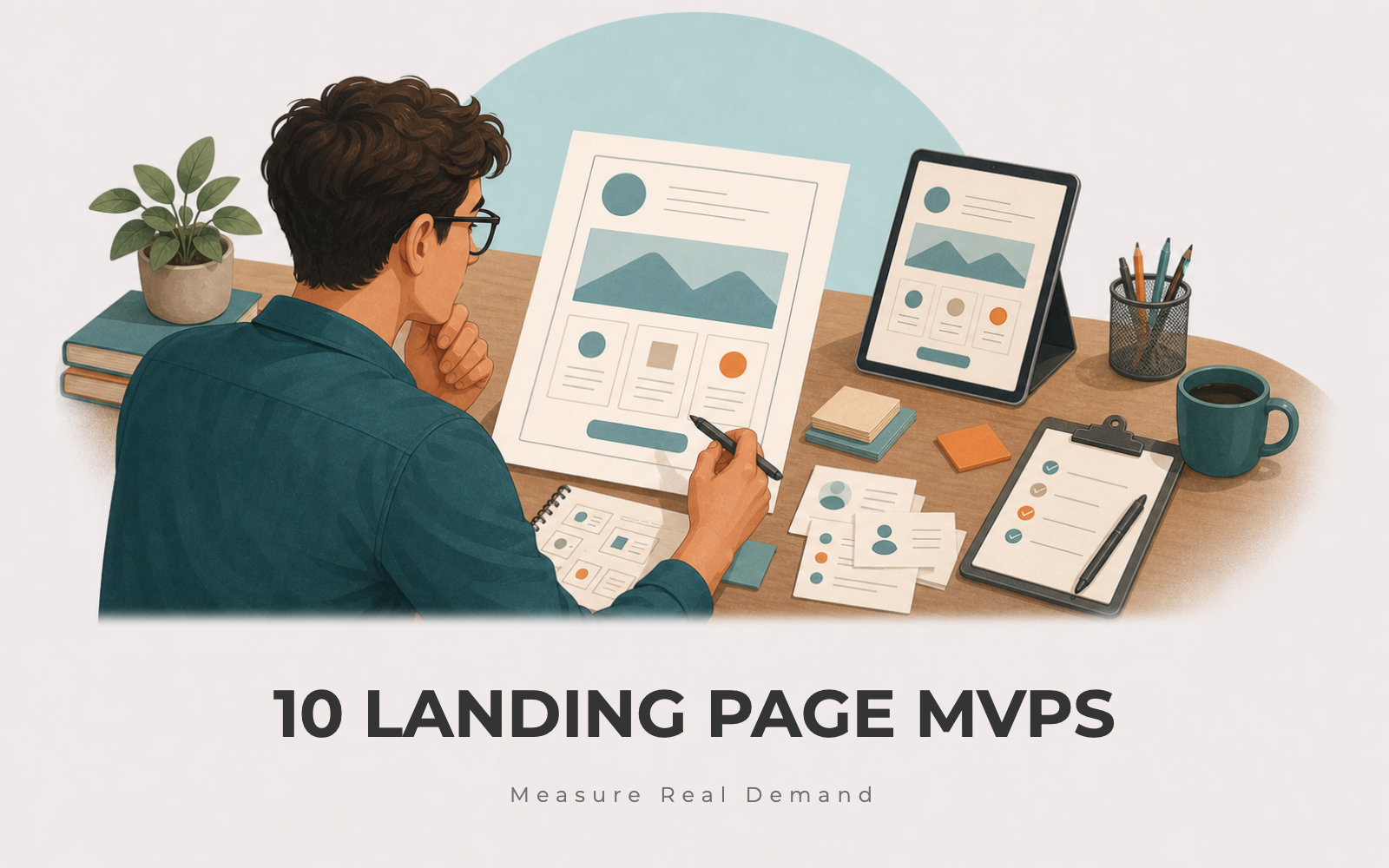
A landing page MVP is a controlled test of a promise. It presents one offer to a defined audience and asks for a proportionate next action before the full product exists.
The page alone validates nothing. Evidence comes from who saw it, why they arrived, what they understood, what they did, and whether that behavior continued after you followed up. A hundred anonymous visits and three emails are not equivalent to three qualified buyers requesting a scoped pilot.
The ten formats below test different risks. Choose the call to action that matches what already exists and what you can honestly deliver.
Write the Experiment Before the Page
Define:
- Audience: Who should recognize the problem?
- Promise: What outcome are you testing?
- Traffic source: How will the right people reach the page?
- Action: What can a visitor reasonably commit now?
- Threshold: What result will make you continue, revise, or stop?
- Follow-up: How will you learn why they acted or declined?
There is no universal conversion threshold. Set one from the cost and purpose of the test. Five qualified pilot requests may be decisive for a narrow B2B offer; a low-priced consumer product may need much more behavior to support the economics. Write the threshold before seeing results so you do not redefine success afterward.
1. Problem-Interview Recruitment Page
Use it to test: Whether a specific group recognizes the workflow enough to discuss a recent example.
Page and traffic: Describe the research question, who should participate, time required, data handling, and what participants receive. Invite people through targeted communities, professional groups, or direct outreach.
Call to action: Apply for an interview by answering two or three fit questions.
Evidence and failure mode: Qualified applications with detailed recent behavior show access to the problem. Generic curiosity does not. If the right people visit but cannot recall the problem, revisit the segment before presenting a solution.
2. Narrow Waitlist Page
Use it to test: Whether the outcome and audience are clear enough to earn future contact.
Page and traffic: State who the product is for, the job it improves, what the first release will and will not do, and the expected update cadence. Send traffic from a relevant founder audience, search query, partner, or direct conversation.
Call to action: Join the waitlist and answer one question about the current workaround.
Evidence and failure mode: Segment fit and useful problem detail matter more than total emails. A waitlist can validate message interest, not willingness to pay or repeated use. Do not call signups customers.
3. Paid Pilot Page
Use it to test: Whether a B2B buyer will pay for a bounded outcome before a full product exists.
Page and traffic: Show buyer, trigger, pilot scope, duration, client responsibilities, success measure, price or pricing process, and what happens afterward. Reach prospects through founder-led sales or trusted partners.
Call to action: Request the one-page scope or book a qualification call.
Evidence and failure mode: A signed, paid pilot with access to the real workflow is strong evidence. Calls from poor-fit prospects indicate targeting or promise problems. Use these AI startup MVP patterns to compare a paid pilot with other tests.
4. Honest Preorder Page
Use it to test: Whether buyers will pay for a clearly specified product delivered later.
Page and traffic: Explain what exists today, what is being funded, expected delivery, limits, cancellation or refund process, and material risks. Reach an audience that already understands the problem rather than buying broad impulse traffic.
Call to action: Place a preorder under explicit terms.
Evidence and failure mode: Completed payments and low avoidable cancellation are stronger than checkout clicks. Do not accept money unless you can manage the funds, communication, delivery, and applicable consumer obligations. If delivery remains highly uncertain, use an interview or waitlist instead.
5. Manual Demo Request Page
Use it to test: Whether buyers understand a new workflow well enough to invest time in seeing it applied.
Page and traffic: Show the before state, the product behavior, one realistic example, and who should request a demonstration. Send targeted outreach or content traffic from people researching the workflow.
Call to action: Request a demo using a real but non-sensitive example.
Evidence and failure mode: Qualified requests and users bringing actual context show relevance. A polished video watched by peers does not. If every demo needs a different product story, the target segment is probably too broad.
6. Calculator or Diagnostic Page
Use it to test: Whether a specific decision is important enough for users to provide inputs and review a result.
Page and traffic: Explain the calculation, required inputs, source or assumptions, limitations, and next step. Search can work well when people already ask the underlying question.
Call to action: Complete the calculation, then save or discuss the result.
Evidence and failure mode: Completion by target users, corrections to assumptions, sharing, and relevant follow-up are useful. A calculator built around invented precision creates false confidence. Make formulas and limitations inspectable.
7. Teardown or Audit Offer Page
Use it to test: Whether a buyer values a diagnosis of one visible artifact or workflow.
Page and traffic: Define what will be reviewed, what the customer receives, what is excluded, turnaround, and how examples are handled. Reach prospects whose public pages or workflows make the problem observable.
Call to action: Submit an eligible artifact or request a paid review.
Evidence and failure mode: Buyers providing real material and continuing into a scoped project show demand. Free submissions from people outside the target segment may prove only that free advice is attractive. Limit the number and qualification criteria.
8. Price-Choice Page
Use it to test: Whether buyers understand different packages and which tradeoff they prefer.
Page and traffic: Present real deliverable differences, customer responsibilities, and who each option suits. Use qualified visitors who have already recognized the problem.
Call to action: Select a package and request purchase or pilot details.
Evidence and failure mode: Selection followed by a sales or payment step is more useful than button clicks alone. Do not show a fake checkout or imply availability that does not exist. Price objections should be recorded alongside scope and trust objections.
9. Alternative-Comparison Page
Use it to test: Whether buyers see a meaningful reason to switch from their current workaround.
Page and traffic: Compare the new approach with manual work, a general tool, an agency, or doing nothing. Use consistent criteria and state where your approach is not a fit. Reach people searching for alternatives or evaluating the status quo.
Call to action: Review a sample, request a migration plan, or discuss fit.
Evidence and failure mode: Visitors naming their current option and asking about switching constraints show decision intent. Straw-man comparisons produce weak trust. Verify competitor facts and date material claims.
10. Concierge Signup Page
Use it to test: Whether customers want the outcome before software automates delivery.
Page and traffic: Explain the finished result, required inputs, human involvement, turnaround, capacity, and price. Invite a small, reachable customer group through direct outreach or partners.
Call to action: Apply for or purchase the hands-on first version.
Evidence and failure mode: Payment, completed intake, use of the result, and a repeat request expose the real workflow. If every engagement becomes custom consulting, narrow the promise. A concierge MVP is valuable because it reveals what should—and should not—be automated.
Diagnose the Result Correctly
Review the funnel as a sequence:
- Did the intended audience see the page?
- Did they recognize the problem?
- Did they understand the promise and limits?
- Did they take the intended action?
- Did qualified people complete the follow-up step?
- Did their behavior support the original risk you wanted to test?
Low action from mismatched traffic says little about the offer. High signup volume with no completed follow-up may indicate curiosity, low trust, or an action that was too cheap to count as evidence. Use the wider customer-validation framework to interpret behavior rather than celebrating a top-line rate.
If you have no audience, use this no-audience validation process to recruit a small relevant test group. Then choose the next artifact from the MVP examples library. A landing page can test a message or commitment, but it cannot prove retention or product value before people use the result.
Finally, keep an MVP distinct from a visual prototype. The MVP versus prototype guide explains why a convincing screen does not substitute for customer behavior. The purpose of the page is a decision: continue, narrow, change the offer, change the audience, or stop.
Martin Bell
Founder of 100 Tasks. Martin Bell has launched or supported 120+ startups and turned Rocket Internet venture-building discipline into a step-by-step system used by 25,000+ founders and startups.