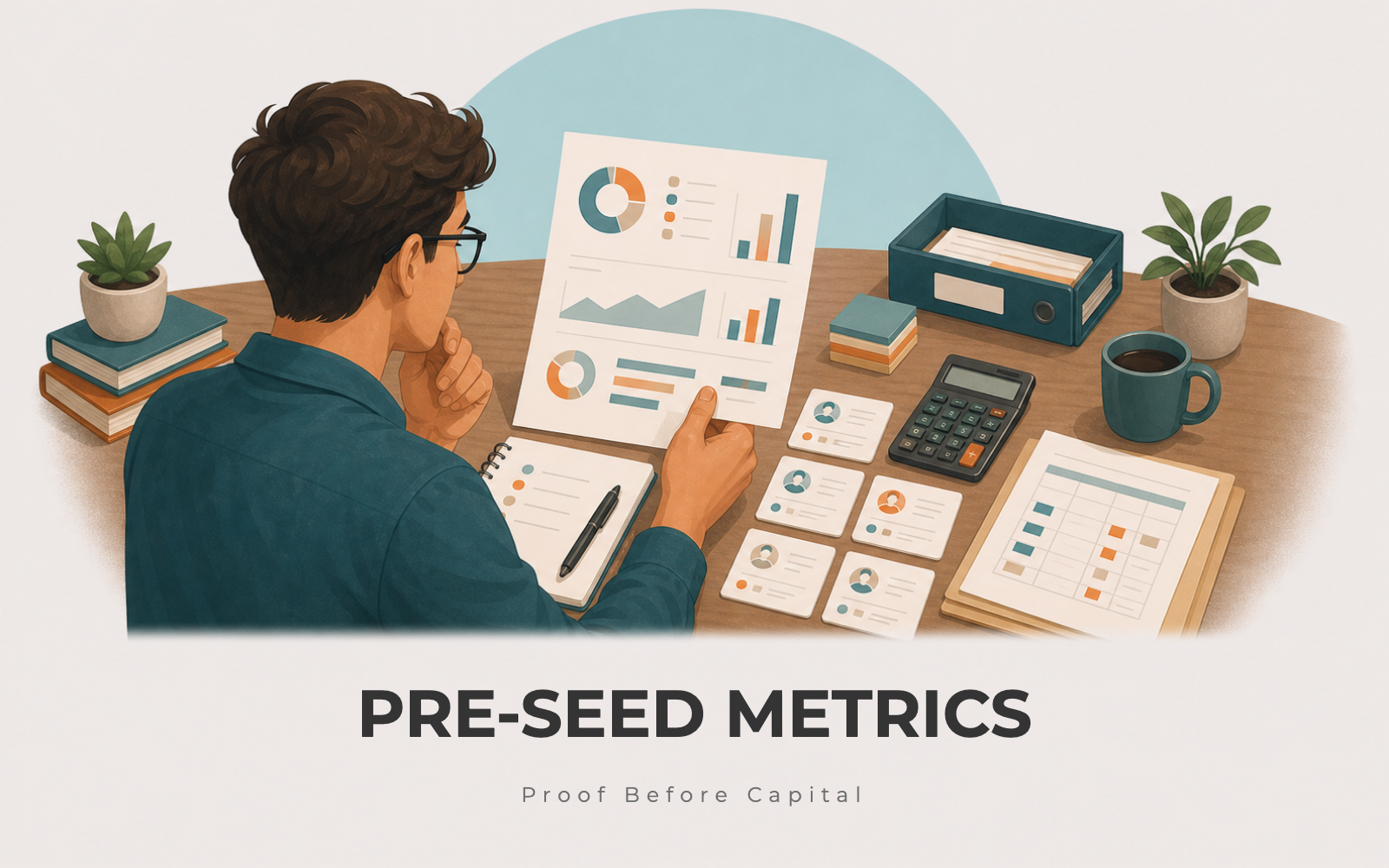
Pre-Seed Startup Metrics: What to Prove Before Raising (2026)
A 2026 guide to the proof investors, advisors, and founders should look for before a pre-seed round.
Founder-friendly guides to startup funding, forecasting, runway, unit economics, and financial decisions, with clear limits and source-backed context.

A 2026 guide to the proof investors, advisors, and founders should look for before a pre-seed round.

Ten complete, annotated pitch scripts for customers, pilots, demos, investors, partners, recruits, internal sponsors, and programs.

Build investor, customer, or partner pitches around a clear audience, problem, evidence, plan, and specific ask—with complete scripts and a reusable template.

Build a driver-based startup financial model that connects customers, revenue, costs, cash, runway, break-even, and sensitivity with one worked example.

Understand pre-money, post-money, dilution, SAFEs, and option pools—and avoid treating an early-stage valuation as a precise or guaranteed measure of company value.

Pre-seed and seed are market labels, not legal classifications. Compare typical evidence, investors, instruments, milestones, and use-of-funds logic.

Understand what pre-seed funding is, what evidence an early founder can prepare, how common instruments differ, and how to run a careful investor process.

Build a bootstrap plan around customer-funded learning, cash runway, staged commitments, and clear signals for staying self-funded or seeking capital.

Prepare a startup for investor due diligence with a practical data-room checklist, workstream owners, issue log, process stages, and founder reverse diligence.

A seed round is an early financing from investors. Learn how SAFEs, notes, and priced equity work, what investors review, and how founders prepare.

Prepare a seed round by defining the milestone, building an evidence-backed investor narrative, running a focused pipeline, organizing diligence, and reviewing deal terms with counsel.

Learn what US founders mean by seed grants, how grants differ from contracts and equity, and how to screen official opportunities before applying.

Compare angels and venture capital funds by source of capital, stage, decision process, governance, timing, terms, and fit—without relying on misleading check-size rules.

Understand how a U.S. startup convertible note works, what happens at financing or maturity, how caps and discounts interact, and which terms require legal review.

Evaluate U.S. startup debt by repayment source, total cost, collateral, guarantees, covenants, and downside—not by the promise of avoiding dilution.

Begin by estimating one-time and monthly startup costs, setting a safe funding target, separating the money, and automating a contribution you can sustain.

A practical guide to startup ownership, cap tables, common and preferred stock, options, vesting, dilution, and the questions founders should review with advisers.

Understand when a U.S. business grant is not repaid like a loan, when funds may be disallowed or recovered, and what to verify before accepting an award.
Most founders are overworked, under-resourced, and forced to build without the operating sequence. 100 Tasks AI turns Martin Bell's 120+ launch process into a 100-task checklist, AI co-founder, Powersheets, and dashboard so you can launch and scale 3-5x faster.