 Martin Bell10 Min ReadPublished Jul 21, 2026
Founder Weekly Review Template (With a Worked Example)
A repeatable 20-minute Friday review that keeps a founder honest: what shipped, what the numbers say, what to decide, and the one priority for next week.
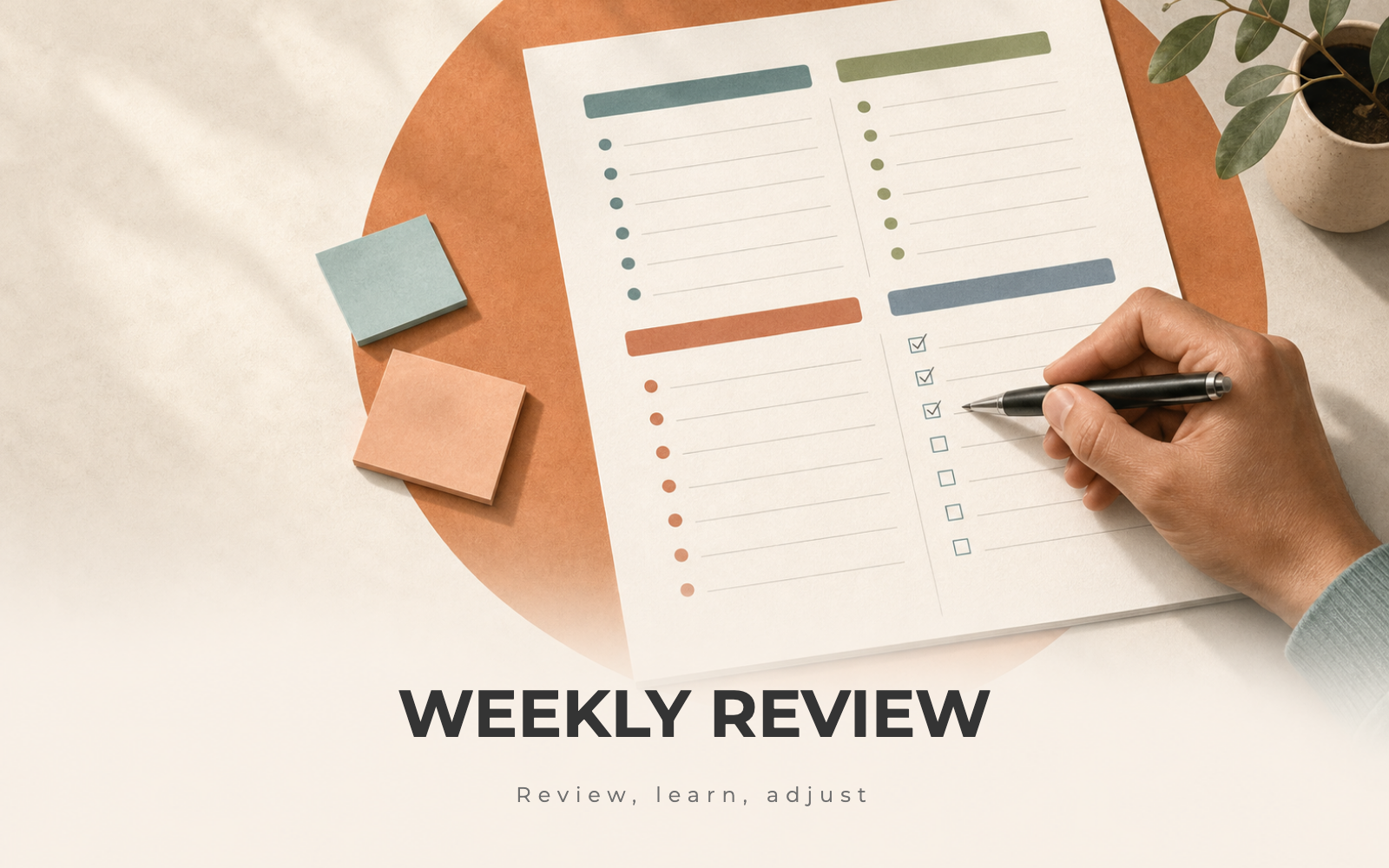
A weekly review is not a status meeting, and it is not journaling. It is a 20-minute checkpoint where you compare what you planned against what actually happened, read a handful of numbers, and commit to one priority for next week. Done every week, it beats occasional heroics, because a startup rarely dies from a single bad decision. It drifts, one unexamined week at a time.
Small, regular corrections compound. A founder who notices on Friday that activation is leaking fixes it while it costs one week of attention. A founder who notices at the end of the quarter pays for three months of the same leak. The review is the cheapest insurance you have against slow, invisible drift.
Think of it as the heartbeat of your founder operating system: the one recurring moment that turns your context, metrics, and customer evidence into decisions. This post gives you a copyable template, a fully worked example from a seed-stage startup, and the rules that keep it to 20 minutes. If you want the wider set of foundations around it, work down the startup checklist for first-time founders; the review is what keeps that checklist honest week to week.
The template: six fields you fill in 20 minutes
The whole review is six fields. Keep them in one document you copy forward every week, so last week's answers sit directly above this week's and the change is visible at a glance. Fill them in this order, reading before deciding.
1. Shipped vs planned. List what you committed to last week and mark each one done, partial, or dropped. The gap between planned and shipped is the most honest signal in the review. A plan that always completes was too small; a plan that never completes is fiction.
2. Key metrics vs last week. Three to five numbers, each beside last week's value and the direction it moved:
| Metric | Last week | This week | Change |
|---|---|---|---|
| e.g. new trials or leads | 9 | 12 | +3 |
| e.g. activation | 4 | 5 | +1 |
| e.g. paying customers or revenue | $2,340 | $2,610 | +$270 |
| e.g. cash or runway | 15 mo | 14 mo | −1 |
Pick numbers that describe your path to value and your survival, not vanity counts. If a metric cannot change a decision, leave it out.
3. What I learned. One to three things, each backed by evidence rather than a feeling. "Users seem confused" is a vibe. "Four of five new accounts stalled at the import step" is evidence you can act on. If you cannot point to a customer action, a number, or a shipped thing, it is not a lesson yet.
4. Blockers. For each thing that is stuck, write three parts: the blocker, the owner, and the single next action that unblocks it. A blocker with no owner and no next action is just a complaint, and complaints roll over forever.
5. Is the top goal still the right one? Re-read your current primary goal and answer yes or no in one line. Most weeks the answer is yes, and that is fine; the point is to catch the week it quietly becomes no. If you run agile OKRs, this is where you hold the week's evidence against the objective, so you adjust the key results before the quarter ends rather than after.
6. Next week's one priority, plus three supporting tasks. Name the single outcome that matters most, then the three tasks that produce it. One priority, not five. Three tasks, not a backlog. Choosing well is its own skill, and startup prioritization frameworks help you rank candidates by leverage and evidence instead of by whichever one feels loudest on Friday.
That is the entire artifact. It fits on one screen, and it forces the four moves a review exists for: face the gap, read the numbers, decide, and commit.
A worked example: one Friday at ClinicNudge
Meet Nadia, founder of ClinicNudge, a seed-stage SaaS that cuts patient no-shows for small physiotherapy clinics with automated reminders and one-tap rebooking. She raised a $600k seed nine months ago, works with one part-time engineer, and has roughly 14 months of runway. Here is her review from a Friday in week 9.
Shipped vs planned. She had committed to three things: ship the patient-list importer, launch one-tap rebooking, and run four clinic demos. The importer shipped. The demos happened, five instead of four. Rebooking slipped, because the engineer hit an SMS-provider limit and the flow is only half-built.
Metrics vs last week.
| Metric | Last week | This week | Change |
|---|---|---|---|
| New trials started | 9 | 12 | +3 |
| Clinics activated (first reminder sent) | 4 | 5 | +1 |
| Paying clinics | 6 | 7 | +1 (2 new, 1 churned) |
| MRR | $2,340 | $2,610 | +$270 |
| Demo to trial rate | 40% | 55% | +15 pts |
What I learned. Three things, each with evidence behind it. The clinic that churned never activated: it signed up, never sent a first reminder, and cancelled on day 12. Of the five activated clinics, only two ever touched rebooking; the other three get their value from reminders alone. And every demo that converted this week asked the same question, "does it pull in our existing patient list?"
Blockers.
| Blocker | Owner | Next action |
|---|---|---|
| Activation still depends on Nadia hand-importing each clinic's patient list | Nadia | Surface the self-serve importer, which is already built but hidden behind manual onboarding |
| Rebooking blocked by the SMS-provider rate limit | Engineer | Request a limit increase, then finish the flow next week |
Is the top goal still the right one? Her seed goal is "prove clinics keep paying after the 14-day trial." The answer is yes, but the churn and activation data sharpen it. The real risk is not willingness to pay; it is getting clinics to their first taste of value fast enough. The goal holds, and the leading indicator she watches shifts to activation speed.
Next week's one priority. Not "finish rebooking." The review just told her rebooking helps two of five clinics, while activation is where the money leaks out. Her one priority: get new trials to first-reminder-sent within 24 hours of signup. The three supporting tasks are to surface the self-serve importer on the first onboarding screen, add a "send your first reminder" step to that flow, and email the six trials that have not activated with a two-line offer to unblock them. Rebooking waits one week.
Notice what the review produced. Not a longer to-do list, but a reallocation. Nadia walked in planning to build rebooking and walked out fixing activation, because the numbers and one churned customer told her where the leak was. That is the review doing its only job: turning a week of raw events into one better decision.
How to keep it to 20 minutes
The review earns its place only if it stays short enough to run every week without dread. My rule of thumb: get about 1% better a week and you're roughly 67% better a year from now. This review exists to bank that 1% — what we learned, what we cut, what compounds — so progress accumulates instead of resetting every Monday. Time each part so the whole thing has a hard stop:
- Minutes 0 to 3: shipped vs planned. Do not relitigate why something slipped, just mark it done, partial, or dropped.
- Minutes 3 to 8: metrics. Fill the table, then look only at what changed. Ignore the numbers that stayed flat.
- Minutes 8 to 13: learned and blockers. Write evidence, not adjectives, and give every blocker an owner and a next action.
- Minutes 13 to 16: the top-goal check. One line, yes or no.
- Minutes 16 to 20: next week's priority and three tasks. Put them straight onto next week's calendar before you close the document.
Two rules protect the 20 minutes. The first is evidence over vibes: if you cannot point to a customer action, a number, or a shipped thing, it does not belong in the review, and the speculation can wait for a longer strategy block. The second is decide, do not discuss: the output of a review is decisions and owners, not open questions. When something genuinely needs research, the review names it and schedules it, then moves on.
The inputs are what make this fast or slow. If your metrics, tasks, and customer notes are scattered across five tools, you will spend the 20 minutes hunting instead of deciding. Keeping them in one place, a dashboard that already tracks your tasks and cadence with an AI co-founder that remembers the decisions and blockers you logged last week, turns the review into reading and choosing rather than assembling. That is part of what 100 Tasks AI is built to hold, though the template works just as well in a plain shared document.
When to run it, and how it fits your other plans
Run it in the same slot every week. Friday afternoon is the natural default: the week's evidence is still fresh, and you set up Monday before you leave. If Friday is chaos for your business, pick another fixed slot and defend it, because the discipline is in the repetition, not the day. A review you keep moving is a review you eventually skip.
This weekly review answers one question: what did we learn, and what do we do next? It is not a capacity or cash plan. A solopreneur weekly planning template answers a different question, namely how many hours you actually have, what fits inside them, and whether the money works, and the two are complementary. The review decides the one priority; the capacity plan decides whether next week can physically hold it. Run the review first, then slot its priority into the capacity plan.
If you work with a cofounder or a small team, keep the same six fields but add an owner to each one and read it together for 20 minutes. The failure mode for teams is turning the review into a status parade where everyone reports activity. The six fields resist that, because each one forces a decision instead of an update.
Where the review quietly breaks
Even a good review decays if you stop paying attention to it. Watch for these:
- It becomes a diary. If you record what happened but never decide anything, you have built a journal, not a review. Every session must end with one priority and owned next actions, or you should shorten it and fix the inputs.
- The metrics never change the plan. Numbers you look at but never act on are decoration. If a metric has not changed a decision in a month, replace it with one that would.
- Blockers roll over untouched. The same blocker showing up three weeks running means it has no real owner or next action. Escalate it, kill it, or route around it, but do not simply retype it.
- The one priority creeps back to five. The moment "one priority" becomes "the top five," the review has stopped protecting your focus. Force the ranking, and let everything below the top item be explicitly next week's problem.
- You skip the goal check because it is obviously yes. That is exactly the week to ask. The goal check is cheap insurance against spending a whole quarter executing a plan the evidence already outgrew.
Run your first review this Friday
Do not wait for a perfect system. This Friday, block 20 minutes and make one pass:
- Copy the six fields into a fresh document.
- Fill in last week from memory, both what you meant to do and what actually shipped.
- Write down three to five numbers, even rough ones, so next week has a baseline to compare against.
- Name one blocker, its owner, and the next action.
- Choose next week's single priority and its three tasks, and put them on Monday's calendar.
Next Friday, do it again with real numbers to compare. The first review is worth little on its own; the tenth is worth a great deal, because by then you can see the line your corrections are drawing. A startup stays on course the way a ship does, not through one dramatic turn but through small adjustments made on a regular schedule, before the drift becomes a crisis.
Inside 100 Tasks AI, this same weekly review is Task 15 in the SETUP stage, and the Dashboard plus Definition-of-Done checklists are the running version of this review loop — the same six fields, kept current between Fridays instead of reset into a blank document.
Martin Bell
Founder of 100 Tasks. Martin Bell has launched or supported 120+ startups and turned Rocket Internet venture-building discipline into a step-by-step system used by 25,000+ founders and startups.