 Martin Bell13 Min ReadPublished Jul 9, 2026Updated Jul 21, 2026
Startup Checklist for First-Time Founders (2026)
A 2026 startup checklist for turning an idea into a validated offer, first customers, and a basic operating rhythm.
A startup checklist should tell a first-time founder what evidence to produce, not just which accounts to open. A logo, domain, entity, and project board can all exist before the business has a clear customer or a problem worth solving.
This checklist follows the order in which uncertainty is best reduced: choose a reachable problem, validate behavior, sell a narrow result, deliver it, establish the necessary legal and financial foundation, then build an operating rhythm. Some compliance steps must happen earlier depending on your jurisdiction, activity, employees, or fundraising plans, so get qualified professional advice where needed.
Use each phase as a gate. Do not wait for perfection, but do not treat a completed setup task as a substitute for customer proof.
Turn the checklist into a weekly control loop
A long startup checklist becomes useful only when it changes what you do this week. The founder operating-system task in the current 100 Tasks framework uses three recurring moments: a Monday plan, a protected midweek customer block, and a Friday review. That cadence keeps task completion tied to evidence rather than activity.
| Review point | What to record | Completion rule |
|---|---|---|
| Monday plan | Three priority outcomes, the expected evidence, and who or what will do the work | Calendar time exists for all three; everything else is explicitly secondary |
| Midweek customer block | Outreach, calls, support themes, transcript notes, and changed assumptions | At least one live customer-learning activity happened; product work alone does not count |
| Friday review | What shipped, what surprised you, where time leaked, and which decisions changed | Evidence and open loops are captured, then next Monday's priorities are drafted |
| Monthly reset | Checklist progress, stale work, operating risks, and the next stage gate | Remove work that no longer supports a customer, revenue, risk, or operational outcome |
The product view below makes the same sequence visible across SETUP, LAUNCH, and SCALE. A percentage is orientation, not proof: the meaningful unit is still a completed task with its required output, decision gate, notes, and next action.
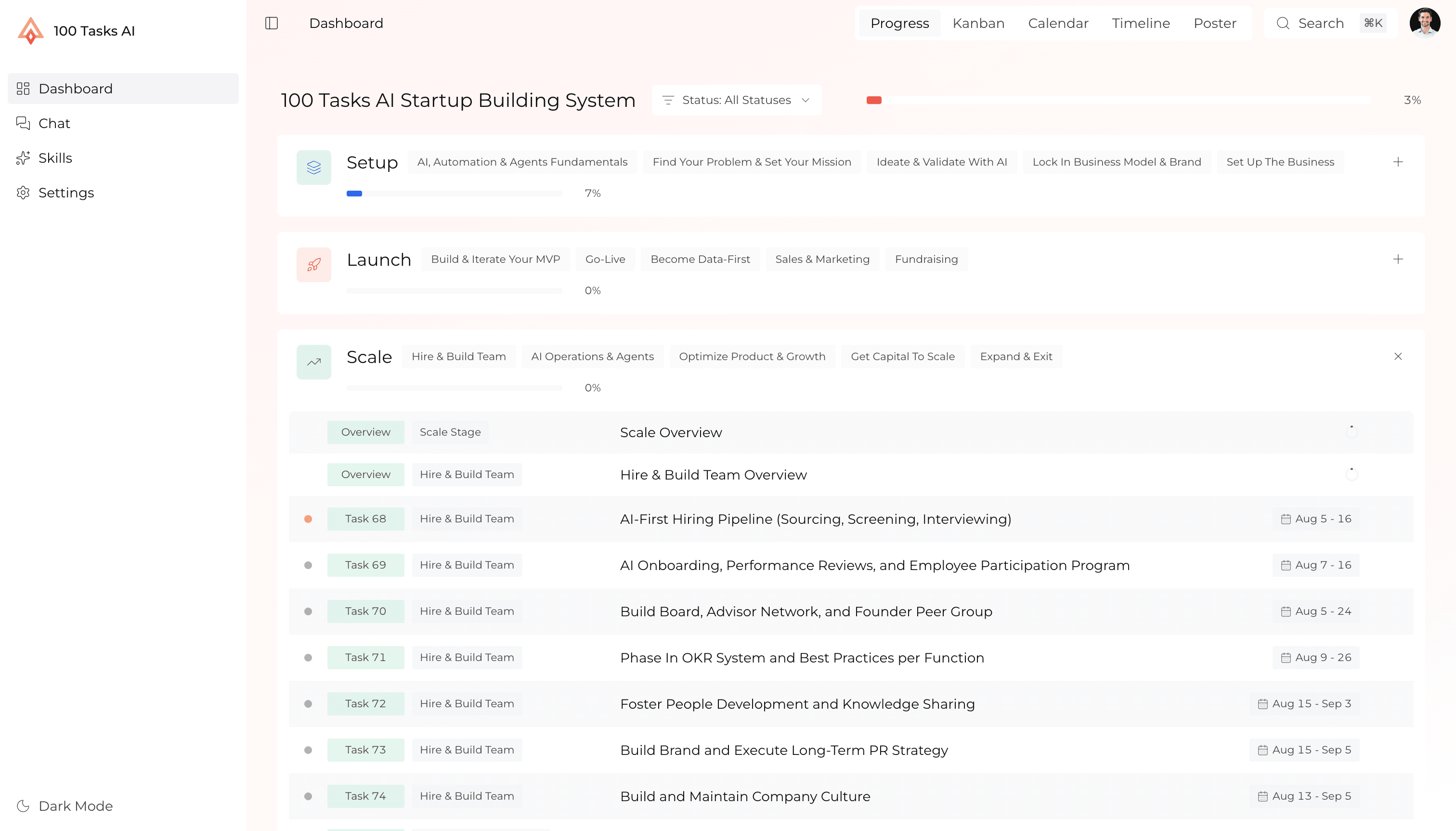
The Progress view keeps stages, substages, task status, and scheduled work together so a founder can review the sequence without treating every task as equally urgent.
Phase 0: Set founder constraints
Before evaluating ideas, decide what the experiment can safely consume.
- Write the hours you can commit each week for the next eight weeks.
- Set a maximum amount of personal cash you can risk.
- List employment, intellectual-property, visa, licensing, benefits, and conflict restrictions.
- Define personal obligations the startup must not endanger.
- Decide who else is affected and what decisions require their input.
- Choose a date for the first continue, change, or stop review.
Required output: a one-page founder constraint sheet.
Gate: the first experiment fits the available time, money, legal boundaries, and risk tolerance.
If you are employed, review relevant agreements before using industry knowledge, accepting customers, or creating intellectual property. Keep devices, accounts, time, and information separate from your employer.
Phase 1: Choose a problem you can reach
Do not begin with “build an app.” Begin with a customer in a recent situation.
- List three customer groups you can locate without paid mass advertising.
- For each group, collect five observable problems or costly workarounds.
- Write the trigger that makes each problem timely.
- Identify the current alternative: tool, employee, service, delay, or doing nothing.
- Score reach, consequence, evidence, validation speed, delivery feasibility, and founder fit.
- Reject ideas that require unacceptable risk, credentials, capital, or dependencies.
- Select one problem for a two-week test.
Use the what-business-should-I-start framework to compare options consistently. If you need raw material, browse startup ideas for founders with no experience, then translate any promising idea into a customer, trigger, and result.
Required output: a problem claim:
When [trigger] happens, [customer] struggles to [job], causing [consequence]. They currently use [alternative].
Gate: you can name at least 20 plausible customers and explain why each may have the problem.
Phase 2: Validate the problem
Validation means testing behavior and commitment, not collecting encouragement.
- Build a research list from at least two independent sources.
- Send short, relevant interview requests.
- Ask about the last time the problem happened.
- Reconstruct the workflow, people, tools, cost, and consequence.
- Record exact phrases and contradictory evidence.
- Identify the user, decision-maker, budget holder, and blockers.
- Compare the problem across several independent interviews.
- Write the riskiest remaining assumption.
Use this interview sequence:
- What triggered the last instance?
- What happened first, then what?
- Where did it slow down or fail?
- What did that cost or prevent?
- What have you already tried?
- Who cares about the result and who can approve change?
The complete customer-validation guide explains how to separate evidence from opinion.
Required output: an evidence table with recent event, current workaround, consequence, frequency, owner, and contradiction for every conversation.
Gate: the same meaningful problem appears in a customer group you can reach, and you know which assumption a real offer must test. There is no universal interview count; look for decision-relevant repetition and keep the sample limitations visible.
Phase 3: Package the smallest complete offer
Sell an outcome before expanding the product.
- Define one customer and one use case.
- Specify the input the customer must provide.
- Specify the completed result they receive.
- Set turnaround time, price, and payment timing.
- State exclusions, revision limits, and customer responsibilities.
- Describe honestly what is manual, experimental, or unavailable.
- Write acceptance or success criteria.
- Create a one-page scope or order document.
Example:
For independent retailers planning a seasonal order, we will clean one sales export, flag the ten products with the largest stock risk, and deliver a replenishment worksheet within three business days. The pilot includes one review call and does not connect directly to store systems.
Required output: a bounded offer a buyer can accept, reject, or negotiate.
Gate: a relevant buyer makes a meaningful commitment—such as payment, deposit, signed pilot, real workflow data, or access to the decision process. Match the commitment to the market; do not call compliments or waitlist signups sales.
Phase 4: Deliver a concierge MVP
An MVP must complete a useful job, even if the backstage process is manual.
- Choose the fastest honest delivery method: service, spreadsheet, prototype-assisted workflow, or narrow software.
- Observe intake rather than assuming it is clear.
- Track time from input to first useful result.
- Record every manual step and exception.
- Watch how the customer uses, shares, or ignores the result.
- Ask what they expected that was missing.
- Ask what they would do if the offer disappeared.
- Offer the next paid use, renewal, or expanded scope when appropriate.
Review minimum viable product examples for formats that test a complete outcome before a complete system.
Required output: one real customer result plus a delivery map showing steps, time, failure modes, and customer-visible value.
Gate: the result is useful enough to support repeated use, a second purchase, a referral, or another defined next commitment. If customers need constant persuasion to use it, investigate the workflow before automating it.
Phase 5: Establish the legal and financial foundation
The right timing depends on activity and jurisdiction. Some registrations, licenses, insurance, tax accounts, contracts, or entity steps are required before trading, hiring, collecting data, or raising money.
- Identify every jurisdiction in which you operate or have obligations.
- Check official sources for entity, name, license, permit, tax, and reporting requirements.
- Decide the ownership structure with legal and tax advice where appropriate.
- Put founder ownership, vesting, roles, decisions, and departures in writing before ambiguity becomes expensive.
- Use written customer and supplier terms appropriate to the risk.
- Confirm privacy, security, consumer, employment, accessibility, and industry obligations.
- Obtain insurance suited to the activity.
- Open appropriate business financial accounts and payment methods.
- Create bookkeeping categories and a receipt process.
- Set aside and schedule taxes based on professional guidance.
- Track founder contributions, loans, reimbursements, and equity accurately.
Required output: a compliance register with requirement, authority, owner, deadline, status, and evidence link; plus a monthly cash ledger.
Gate: the business can lawfully accept and deliver the next transaction, obligations have owners and dates, and financial records reconcile.
Do not copy another startup’s setup. A solo local service, an employer with staff, a regulated marketplace, and a venture-funded software company have different requirements.
Phase 6: Build the first-customer pipeline
Early acquisition is a learning process, not a channel-scaling exercise.
- Define exactly what counts as a customer.
- Build a qualified account list with a relevance reason for each entry.
- Prioritize accounts with a recent trigger and reachable decision-maker.
- Write one research message and one direct-offer message.
- Use a finite, respectful follow-up sequence.
- Track source, reply, conversation, offer, decision, loss reason, and referral.
- Ask every relevant conversation for one introduction.
- Preserve customer language for future pages and sales materials.
The first 10 customers playbook provides sourcing methods, outreach scripts, and a stage-by-stage system.
Required output: a pipeline with real accounts, next actions, owners, and dates.
Gate: several independent customers buy for a recognizably similar reason. Ten is a useful learning milestone, not proof of scalable acquisition.
Phase 7: Install product and business metrics
Choose metrics that describe the customer journey and the company’s survival.
- Define the activation event: the first observable receipt of value.
- Define the relevant return or retention interval.
- Track eligible users, starts, completed outcomes, repeat outcomes, and drop-off.
- Track leads, qualified conversations, offers, wins, and loss reasons.
- Track revenue, refunds, direct delivery cost, gross margin estimate, cash, and monthly net burn.
- Track founder or team hours spent per delivered result.
- Annotate major pricing, segment, product, and channel changes.
- Review raw customer examples alongside ratios.
Basic formulas:
Activation rate = customers reaching the defined first-value event ÷ eligible new customers
Repeat rate = customers completing the workflow again in the next relevant period ÷ customers eligible to repeat
Gross margin = (revenue − direct cost to deliver) ÷ revenue
Runway months = available cash ÷ expected monthly net cash outflow
These metrics require consistent definitions. They do not have universal healthy values. A yearly tax workflow and a daily team tool should not share a retention window.
Required output: a one-page weekly dashboard with definitions and source links.
Gate: the founder can explain what changed, why it changed, and which customer evidence supports the next decision.
Phase 8: Create a founder operating rhythm
A startup becomes chaotic when insights, decisions, tasks, and metrics live in unrelated places.
- Choose one place for current priorities and owners.
- Maintain a decision log with date, context, choice, and review trigger.
- Link customer evidence to product and marketing decisions.
- Set a weekly review time.
- Limit work in progress.
- Separate experiments from maintenance and obligations.
- Keep a risk and compliance review cadence.
- Archive stale priorities instead of carrying them forever.
A practical weekly review asks:
- What customer or revenue evidence changed?
- Which promised outcome shipped?
- Where did customers fail to reach value?
- What happened to cash and delivery time?
- Which assumption is now riskiest?
- What single outcome matters next week?
Required output: one weekly page containing metrics, evidence, decisions, risks, and the next priority.
Gate: every active project supports an explicit customer, revenue, risk, or operational outcome.
Phase 9: Decide whether to deepen, broaden, or stop
Do not treat persistence as an automatic virtue. Review the accumulated evidence.
Deepen the current direction when
- Similar customers buy for a similar reason.
- The delivered result creates observable value.
- Repeat use, renewal, referral, or expansion appears.
- Delivery becomes more predictable.
- The next bottleneck is understood.
Narrow or change when
- One segment responds much more strongly.
- The user and buyer are consistently different.
- Customers value a smaller outcome than your vision.
- A repeated delivery step suggests a better product wedge.
Stop or pause when
- The problem does not recur in qualified customer evidence.
- Buyers repeatedly choose an adequate alternative.
- The economics, risk, or founder constraints do not work.
- Progress requires a dependency you cannot responsibly secure.
Required output: a written decision with supporting evidence, contradictions, next investment, and stop condition.
The first 30 days in one view
Week 1
- Set constraints.
- Score three ideas.
- Choose one customer and problem.
- Source 20 relevant people.
Week 2
- Conduct behavior-based interviews.
- Synthesize triggers, workarounds, and consequences.
- Identify the buyer and riskiest assumption.
Week 3
- Package the smallest complete offer.
- Make direct offers.
- Complete required pre-transaction legal and financial setup.
Week 4
- Deliver the first result.
- Record use, time, cost, and customer questions.
- Ask for the next commitment.
- Make a continue, narrow, change, or stop decision.
Thirty days may produce a sale, a clearer niche, or a well-supported decision not to continue. All three can be progress if the evidence is honest.
What not to put ahead of proof
Unless required for law, safety, contracting, or the next real transaction, do not let these become the main project:
- A complete visual identity.
- A feature-rich product.
- A large content calendar.
- A complex project-management setup.
- Automated acquisition before manual messages work.
- Hiring before the repeated bottleneck is visible.
- Fundraising before the use of capital is clear.
The first-time founder’s job is not to make the startup look complete. It is to turn the largest uncertainty into the next piece of trustworthy evidence. Work down this checklist in order, honor the gates, and add complexity only when customers, compliance, or operations require it.
Martin Bell
Founder of 100 Tasks. Martin Bell has launched or supported 120+ startups and turned Rocket Internet venture-building discipline into a step-by-step system used by 25,000+ founders and startups.