 Martin Bell13 Min ReadPublished Jul 21, 2026
SEO for Startups: A Founder's Playbook (2026)
For non-technical founders: how to tell whether search is worth your time, then earn compounding organic traffic with product-led content instead of AI-generated filler.
Search engine optimization is the practice of earning free, recurring traffic from Google by publishing pages that answer what your buyers already search for. For a startup, it is one of the few channels that compounds: a page you write once can send you qualified readers every month for years, and no competitor can switch it off by outbidding you.
It is also the wrong channel to start with if you need revenue this month. SEO has a slow ramp. Google's own starter guide is blunt that changes "could take several months" to show up and that there are "no secrets here that'll automatically rank your site first" (Google Search Central). Treat search as a long-term asset you build alongside faster channels, not a shortcut to your first ten customers.
This guide is for a non-technical founder. It covers how to decide whether SEO fits your stage right now, how search intent and topic clusters actually work, what content AI cannot flood the web with, the on-page and technical basics kept deliberately simple, how to measure progress in Google Search Console, and what to make of AI Overviews. By the end you will have one concrete next move: publish a single product-led cluster post.
Is SEO the right channel for you right now?
Before you spend a single afternoon on it, decide whether search deserves your attention yet. This channel rewards patience and punishes urgency, so the honest answer for many early founders is "not first."
Start now if most of these are true:
- People already search for what you sell — a recognizable category or a named, painful problem.
- You can wait three to six months to see meaningful traffic without losing faith.
- You have something to say that only you can say: real customer data, a worked example, an opinion earned from doing the work.
- You will publish consistently, not once.
Wait if:
- You need paying customers in the next 60 days. Do founder-led outreach instead.
- You have no product-market signal yet. Ranking for the wrong thing wastes the entire slow ramp.
- You cannot commit to publishing for at least a quarter.
Either way, SEO earns its place inside a complete go-to-market strategy, never as a replacement for one. It is one of several customer acquisition channels for startups worth testing, and in the early days it usually sits behind direct outreach and warm networks that produce customers this week rather than this quarter.
The reason to start anyway, even while faster channels carry the load, is the moat. Paid ads rent attention: the moment you stop paying, the traffic stops. A cluster of pages that ranks is an owned asset that keeps working while you sleep, and it gets harder for competitors to dislodge as it accumulates links and history. At Rocket Internet, we built audience before product — email lists, communities, partnerships, customer conversations, waiting lists, pilot users. SEO is that same instinct on a longer clock: the page keeps returning qualified readers long after you hit publish, so you end up owning the channel instead of renting the attention. It compounds the same unglamorous way small weekly gains do — roughly 1% better a week works out to about two-thirds more over a year. The curve is quiet for a while and then surprisingly durable.
Start with search intent, not keywords
The single most useful SEO skill is not finding keywords. It is reading the intent behind a query and publishing the exact thing that satisfies it. Every search a buyer types falls into one of three practical intents.
| Intent | Example query | What the searcher wants | What to publish |
|---|---|---|---|
| Informational | "how to price a b2b pilot" | To learn something or solve a problem | A clear how-to guide or explainer |
| Commercial investigation | "best crm for early startups", "notion vs airtable" | To compare options before buying | A comparison, curated list, or honest teardown |
| Transactional | "[your category] pricing", "sign up [tool]" | To act now | A product, pricing, or signup page |
Match the page to the intent, and put only one intent on a page. Someone searching "best crm for startups" wants a comparison; drop them on a 3,000-word history of CRM software and they leave, which teaches Google your page is the wrong answer. You read intent by searching the query yourself and studying what already ranks: if the whole first page is listicles, Google has decided that query wants a list, and a single-product page will not break in.
Weight your early effort toward the commercial-investigation layer. Informational queries build awareness but sit far from a purchase; transactional queries convert but are few. The middle band — buyers actively comparing before they decide — is where startups win, because that is exactly where your first-hand product knowledge is more useful than a generic roundup.
Organize content as topic clusters, not scattered posts
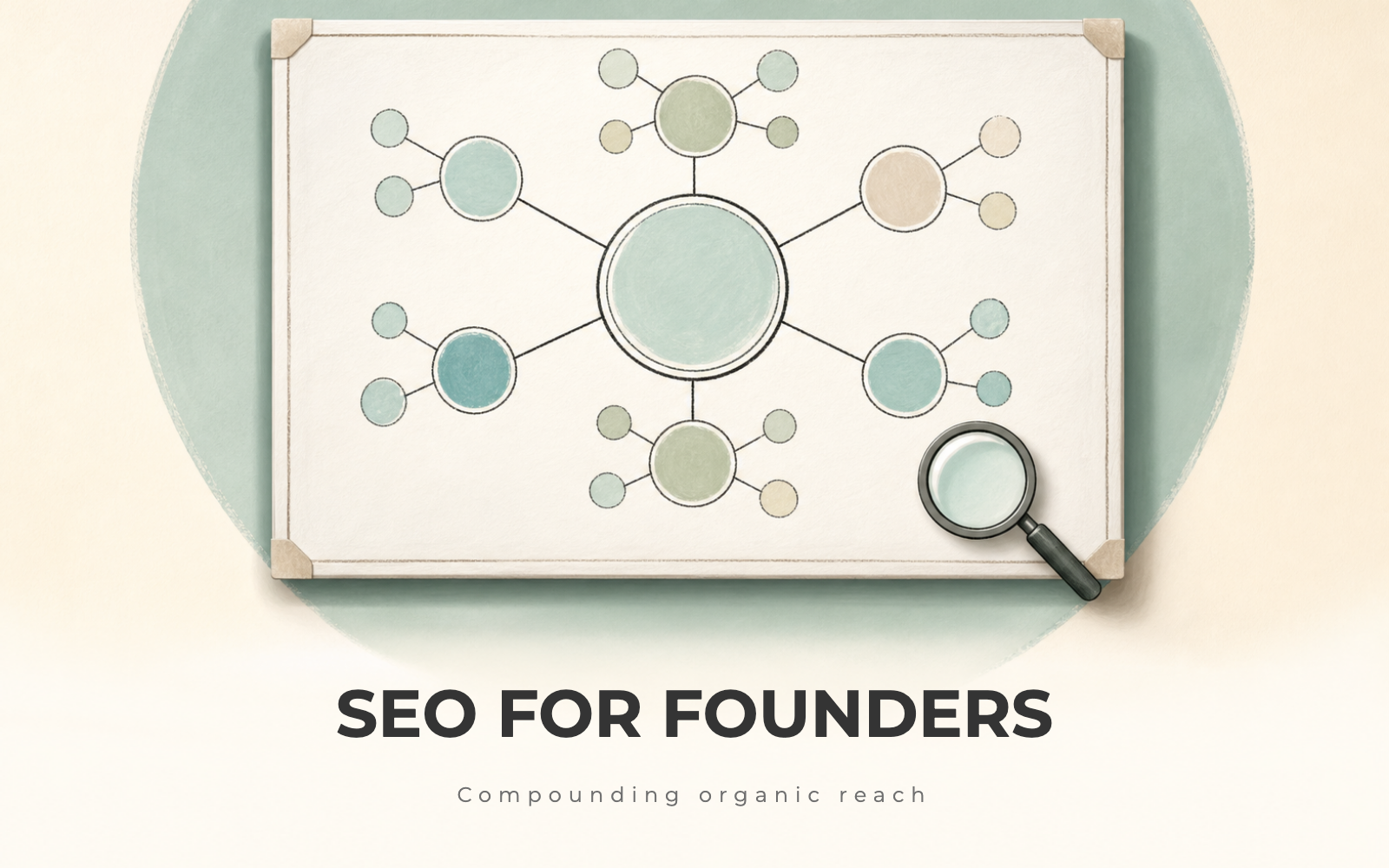
Google rewards demonstrated depth on a topic, not a pile of unrelated posts. The structure that produces depth is the topic cluster, also called hub and spoke.
- A hub page covers a broad topic at a high level ("go-to-market strategy").
- Spoke pages each answer one specific sub-question in depth ("customer acquisition channels", "how to write a cold email", "SEO for startups").
- Every spoke links up to the hub and across to its nearest siblings; the hub links down to each spoke.
This works on two audiences at once. A reader gets a guided path from the overview into the precise answer they came for, and Google sees a tightly interlinked set of pages that plainly cover a whole theme rather than one shallow post.
You are inside a live example right now. This blog groups its marketing writing into a go-to-market cluster. The hub is a go-to-market strategy guide; the spokes include a piece on customer acquisition channels, one on content distribution, one on email marketing, and the SEO post you are reading. Each spoke links back up to that hub and sideways to the siblings a founder would naturally read next — which is why this post pointed you to the strategy hub above and threads related channels throughout. Copy that shape: pick one theme you want to own, write one hub and five to fifteen spokes beneath it, and interlink them deliberately.
Write product-led content only you can write
Here is the uncomfortable reality of 2026: generic content is now free and infinite. Anyone can prompt a model to produce a competent "what is SEO" article in seconds, and the web is drowning in it. Google has responded by rewarding what it calls people-first content — "content that's created primarily for people, and not to manipulate search engine rankings" — and pulling back from pages made mainly to attract search visits by mass-summarizing other sources (Google Search Central).
So the only content worth your hours is content a competitor cannot regenerate with a prompt. Ask one question before you write anything: could a rival reproduce this by asking an AI? If yes, it is a commodity and it will not differentiate you. If it needs something only you have, it is a moat.
Things only you can write:
- Real numbers from your own funnel, pricing tests, or experiments.
- A fully worked example with actual inputs and outputs, not a hypothetical.
- A teardown of a decision you made and what it cost you.
- A framework you run every week, including the edge cases.
- Anonymized patterns pulled from your customer conversations.
This is why customer insight is your richest content raw material. The founder content system for turning one customer insight into many assets gives you a repeatable way to mine that material, so every sales call and support ticket becomes a candidate post no one else on the internet could publish.
Do keyword-to-intent research cheaply
You do not need a paid research suite to begin. The best queries are hiding in plain sight, and the highest-signal source is one only you can see.
Free sources, in rough order of value:
- Your own sales calls and support tickets. The exact words customers use are the exact words they search. Nobody else has this data about your buyers.
- Google's own surfaces: autocomplete, the "People also ask" box, and the "related searches" at the bottom of the results page.
- Communities where your buyers gather — subreddits, Slack groups, niche forums. Read how they phrase the problem in their own words.
- Competitor headings. Skim the H2s of the pages already ranking for your topic to see the sub-questions Google is rewarding.
Then run a short loop on each candidate:
- Phrase the customer's problem as the query they would actually type.
- Search it and read the top results to confirm the intent — guide, comparison, or product page.
- Ask whether you can genuinely be the best answer, given your unique input.
- Keep it only if it is both winnable and close to your buyer. A high-volume term you cannot rank for, or a term your buyer never searches, is not worth the ramp.
If you would rather that step be structured than improvised, the SEO Brief Builder Skill inside 100 Tasks AI turns a chosen query and its intent into a working brief — the title, the headings, and the internal links — so you draft against the search job instead of guessing at it. The tool is beside the point; writing one page against one clear intent is the whole discipline.
Keep the on-page basics simple
On-page SEO is where founders over-engineer. You need far less than the plugins imply.
- One clear title. Give each page a single descriptive title that matches the query and reads like a person wrote it, not a keyword string. This is your biggest on-page lever, and Google's starter guide treats a good title as a fundamental (Google Search Central).
- Descriptive headings. Use the page's main heading for its job and the sub-headings for the questions a skimming reader has. Someone should be able to scan only the headings and still get the gist.
- Internal links with real anchor text. Link to your hub and siblings using words that describe the destination, like "customer acquisition channels" — never "click here" and never a bare URL.
- A useful meta description. Write it as a snippet that earns the click. Google may rewrite it, and that is fine.
That is most of the job. Resist keyword stuffing, exact-match repetition, and writing for the crawler. Build the clearest possible page for one intent and let the basics carry it.
Cover the technical basics in plain language
Technical SEO sounds intimidating and mostly is not. For a new site, three things need to be true, and modern site builders handle most of them for you.
- Crawlable. Google has to be able to reach the page — not blocked in
robots.txt, not stranded behind a login, and linked to from other pages. If Google cannot crawl it, nothing else on this page matters. - Canonical. Each piece of content should have one preferred URL. When the same content is reachable at several addresses, a canonical tag tells Google which one counts, so you do not split your signals across duplicates.
- Sitemap. An XML sitemap is a simple file listing your real pages. Submit it in Google Search Console so Google can reliably discover everything you publish.
Add HTTPS, a layout that works on a phone, and pages that load at a reasonable speed, and you have cleared the technical bar for a startup. What technical SEO cannot do is manufacture demand. It removes the obstacles between Google and a good page; it does not make a thin page rank. A flawlessly crawlable page of commodity content still loses to a slightly slower page that happens to be the best answer.
Measure with Google Search Console
Buy nothing else to start. Google Search Console is free, first-party, and shows you what Google actually sees on your site. Once your domain is verified, review it monthly — not daily, because the channel moves far too slowly for daily checks to mean anything.
Each month, answer four questions:
- Are the pages indexed? Use the Pages report and URL Inspection to confirm Google has them. An unindexed page cannot rank at all.
- Which queries are you appearing for? Check that they match the intents you targeted. Surprises are useful here — sometimes you rank for something better than you planned and should lean into it.
- Where are the near-misses? Pages sitting at average position five to fifteen are often one honest revision away from the first page. Improve those before writing anything new.
- Where is the intent mismatch? Rising impressions with almost no clicks usually mean your title or your content does not match what the searcher actually wanted.
Do this two or three times and you will feel the real rhythm of the channel: publish, wait, read the data, revise. That loop, repeated, is the entire job.
The honest reality of AI Overviews and AI search
You have seen Google answer questions directly at the top of the results with an AI Overview, and founders keep asking what special trick gets them cited there. The honest answer, from Google itself, is: nothing special. Its guidance states there are "no additional requirements to appear in AI Overviews or AI Mode," and that you do not need new machine-readable files or "special schema.org structured data" — foundational SEO and helpful, people-first content are what surface (Google Search Central). Anyone selling you gimmick markup or an "AI optimization" hack is selling you nothing.
There is a real risk to name, though. When an AI answer fully satisfies an informational query inside the results page, the searcher never clicks through. That erodes traffic on precisely the generic questions that were already commodity content. The strategic response is the same one this whole guide points toward: weight your effort toward content that needs the click — your product-led comparisons, worked examples, and decision pages — and away from thin explainers an AI can summarize away.
It also means search should never be your only surface. Search is rented reach: you do not own the algorithm, the results page, or the AI answer, and any of them can change overnight. Pair it with deliberate content distribution across owned and community channels so the same assets reach people in more than one place, and convert the visitors search sends you into an audience you actually own with email as the channel you keep. A search reader is a stranger Google lent you; a subscriber is a relationship no algorithm can revoke.
A realistic timeline
Set expectations before you start so you do not quit in week six, when nothing visible has happened yet. These are ranges, not promises.
| Timeframe | What is realistic | What to do |
|---|---|---|
| Month 1 | Pages get crawled and indexed; little to no traffic. | Publish your first hub and two or three spokes. Verify Search Console and submit the sitemap. |
| Month 3 | A few pages surface on page two or three for long-tail queries; first trickles of traffic. | Read Search Console. Revise the near-miss pages. Keep publishing spokes. |
| Month 6+ | Your best cluster starts ranking on page one for winnable terms; traffic begins to compound. | Double down on what ranks. Expand the winning cluster. Merge or retire what did not work. |
A brand-new domain in a crowded space moves slower; a focused niche with little competition can move faster. The pattern, not the exact dates, is the point: quiet, then a slow rise, then compounding.
Your first move
Do not try to do all of this at once. Do one thing this week: publish a single product-led cluster post.
- Pick one query your buyers genuinely search that sits close to your product — ideally a commercial-investigation query where your real experience is the differentiator.
- Confirm the intent by reading what already ranks for it.
- Write the one page only you could write, using your own data or a fully worked example.
- Give it a clear title and descriptive headings, and link it to the hub and one sibling.
- Submit your sitemap in Search Console and note the date.
Then wait, watch the data, and publish the next spoke. SEO for startups is not a launch; it is a compounding habit. The founders who win at it are rarely the ones who know the most tricks — they are the ones who ship one useful, un-copyable page, and then do it again.
Inside 100 Tasks AI, that same loop is Task 64 (ad copy + SEO pipeline), run with the SEO Brief Builder and Content OS Skills — an AI co-founder turning this week's query and this week's customer insight into the next page you ship.
Martin Bell
Founder of 100 Tasks. Martin Bell has launched or supported 120+ startups and turned Rocket Internet venture-building discipline into a step-by-step system used by 25,000+ founders and startups.