 Martin Bell11 Min ReadPublished Jul 13, 2026Updated Jul 21, 2026
How to Pre-Sell Your Startup Idea Before Building (2026)
A practical 2026 path from problem interviews to deposits, paid pilots, or preorders—without pretending an unfinished product already exists.
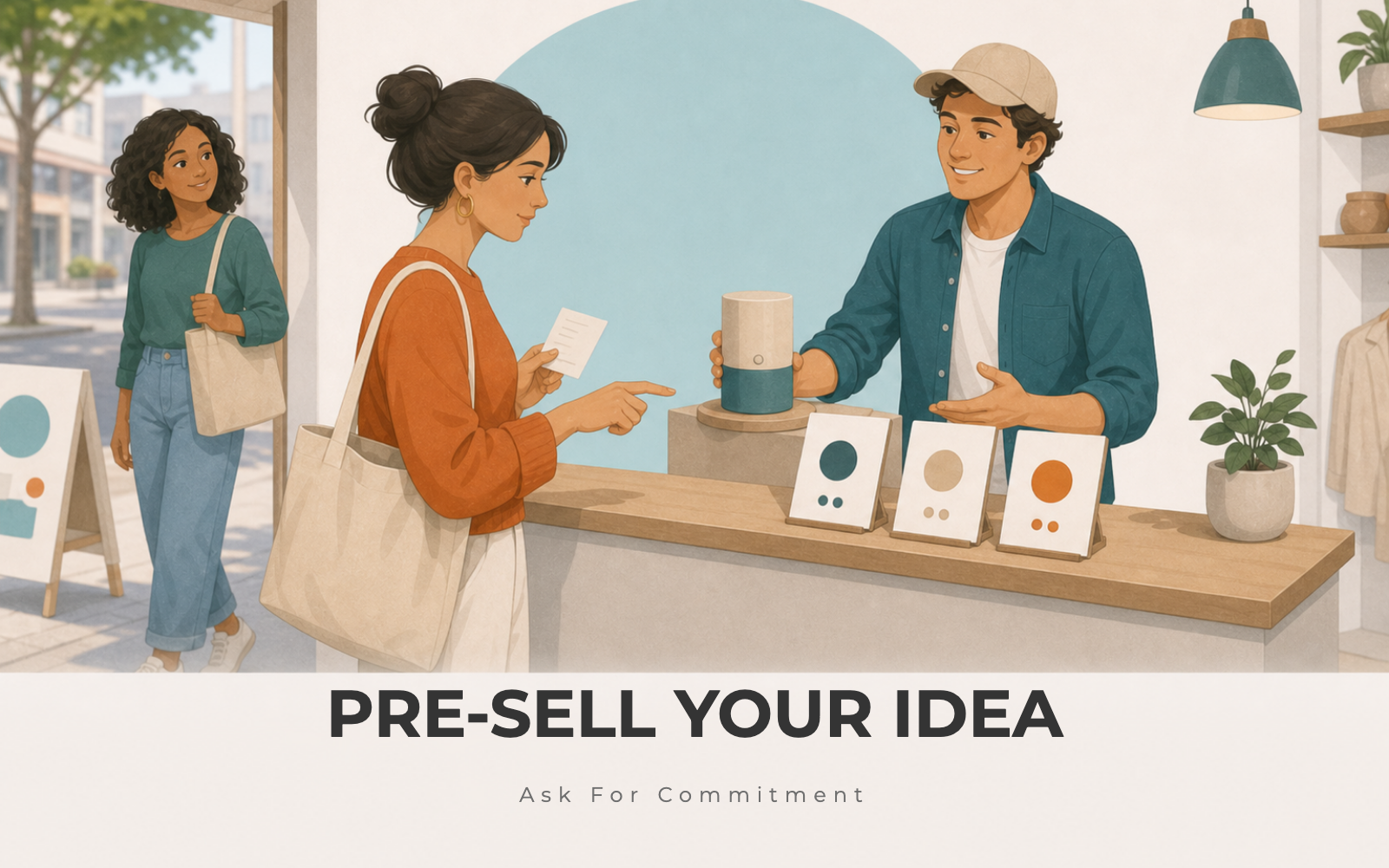
Pre-selling means asking a real customer for a meaningful commercial commitment before you invest heavily in the full product. That commitment might be a paid discovery project, refundable deposit, preorder, paid pilot, or founding-customer agreement.
The point is not to finance an uncertain build with clever copy. It is to test whether a specific buyer values a specific outcome enough to accept price, timing, scope, and risk. A waitlist tests interest. A pre-sale tests a decision.
Done well, pre-selling gives you sharper requirements, early cash, delivery partners, and a reason to build in a particular order. Done poorly, it creates refund obligations, rushed promises, and damaged trust. The difference is honest disclosure and a narrow offer you can fulfill even if the final product changes.
This guide shows how to choose a pre-sale format, write the offer, ask for commitment, deliver an early version, and decide what the evidence justifies.
Know What a Pre-Sale Can and Cannot Prove
A pre-sale can show that a buyer understands the problem, accepts your proposed outcome, and will cross a commercial threshold under stated terms. It can also reveal the real decision process: stakeholders, budget, procurement, timing, and objections.
It cannot prove that the finished product will retain users, scale technically, or acquire customers profitably. Ten deposits from your personal network may not represent a broader market. One enterprise pilot with custom requirements may validate a consulting project rather than repeatable software.
Define the question before the campaign:
Will [specific buyer] commit [money/access/time] to receive [defined outcome] by [date] under [clear delivery and refund terms]?
That question creates a pass or fail. “See if people are interested” does not.
If you do not yet know which problem or buyer to test, start with the customer validation process rather than rushing to collect payments.
Choose the Commitment Format That Matches the Risk
Not every startup should use the same pre-sale mechanism.
| Format | Best when | Customer receives now | Evidence strength |
|---|---|---|---|
| Paid discovery | The problem is complex and scope is uncertain | Audit, workshop, plan, or prototype specification | Strong evidence for problem and willingness to pay for expertise |
| Refundable deposit | Delivery is plausible but date or final shape is uncertain | Reserved place and defined refund right | Stronger than a waitlist; weaker than full payment |
| Preorder | Product, price, and delivery window are concrete | Order confirmation and future delivery | Strong commercial evidence if terms are clear |
| Paid pilot | The outcome can be delivered manually or with an early product | Bounded service, test, or implementation | Strong evidence for B2B value and buying process |
| Founding-customer agreement | Buyer wants influence, access, and an ongoing relationship | Early access, structured feedback, service, and commercial terms | Strong but may create custom expectations |
| Letter of intent | Procurement cannot pay yet but can document conditional intent | Written conditions for a future purchase | Useful process evidence, but not a sale |
Choose the lowest-risk format that still tests the assumption. If delivery is uncertain, a paid discovery engagement may be more honest than a full annual subscription. If you can create the outcome manually, a paid pilot can test value before automation.
Letters of intent and waitlists can support the evidence, but do not count them as revenue. The closer a commitment gets to money, access, and a scheduled implementation, the more it reveals.
Pass Four Evidence Gates Before Asking for Money
Pre-selling too early turns avoidable uncertainty into a customer obligation. Pass these gates first.
1. Problem gate
Several unrelated target buyers describe a recent version of the same problem. They can explain the current workaround and consequence without hearing your solution first.
2. Buyer gate
You know who feels the problem, who owns the outcome, who controls budget, and who can block implementation. In a small company, one person may hold all four roles. In a larger one, they rarely do.
3. Outcome gate
You can state what will be better after delivery in observable terms. “AI-powered productivity” is not an outcome. “Draft and approve the weekly client report in under two hours” is.
4. Delivery gate
You have a credible route to the promised result even if automation is incomplete. That may include founder labor, a manual back office, a no-code workflow, or a deliberately narrow service. The concierge MVP examples show how hands-on delivery can become a learning advantage.
If one gate fails, do not improve the checkout page. Resolve the underlying uncertainty.
Write a One-Page Founding Offer
The offer is a contract with reality before it becomes a legal contract. Keep it plain enough that the buyer can explain it internally.
Use this structure:
Buyer and problem
“For independent recruitment agencies that spend more than a day assembling monthly client reports.”
Promised outcome
“Produce and approve one consistent client report in under two hours using your existing source files.”
What the first version includes
- workflow setup for one team;
- two report cycles;
- founder-led quality review;
- a weekly 30-minute improvement session; and
- export in the customer's current format.
What it does not include
- automatic CRM integration;
- custom data warehousing;
- reports for other departments; or
- an unlimited self-serve software license.
Timing and customer responsibilities
State the start date or delivery window, input deadlines, access required, named owners, and what happens if either side is late.
Price and payment schedule
Show the exact amount, taxes where applicable, when payment is collected, what portion is refundable, and the conditions for a refund or cancellation.
Success and next decision
Define the evidence you will review. For example: two reports approved in under two hours with no client-visible source errors. Then state what happens after success: end the pilot, continue monthly, convert to software, or agree a new scope.
Product status
Use direct language: what exists, what is manual, what is experimental, and what has not been built. Never use a mockup in a way that implies the demonstrated workflow already works.
Before accepting money, make sure your terms, invoicing, tax handling, privacy disclosures, refund approach, and delivery promises comply with the rules that apply to your location, customer, and sales channel. Get qualified advice when the obligations are unclear.
Price the Risk You Are Actually Taking
There is no universal “founding customer discount.” Price should reflect the outcome, delivery effort, uncertainty, and access the customer receives.
Three useful pricing approaches are:
Paid pilot fee: Charge for a bounded result. Appropriate when you will perform real setup, delivery, and review. A lower-than-future price can make sense if the scope is smaller, not because early work has no value.
Refundable reservation: Collect a smaller amount to reserve limited onboarding capacity. State exactly when the deposit becomes refundable or is applied to the purchase.
Milestone payments: Collect portions after defined outputs, such as discovery, working prototype, first live cycle, and final review. Useful when the buyer wants to control delivery risk.
Avoid lifetime deals for products with meaningful recurring costs unless you understand the economics. Avoid deep discounts that attract buyers only because the price is abnormal. And do not invent a fake “regular price” that nobody has paid.
A useful test is whether the price creates a real decision. If every interviewee pays €5 as a favor, you may have tested goodwill. If the amount is so high that you need enterprise-grade proof you cannot provide, you are testing risk tolerance rather than demand.
Build the Sales Path Before the Sales Page
For the first few pre-sales, conversation beats traffic. Start with 15-30 target buyers sourced from interviews, professional communities, direct research, or relevant introductions. If you have no audience, the no-audience validation guide explains how to find reachable evidence without waiting to build one.
Use a simple sequence:
- Confirm the recent problem and consequence.
- Explain the founding offer in the buyer's language.
- Show the delivery path or sample outcome.
- Discuss scope, risk, price, timing, and stakeholders.
- Ask for the commercial commitment.
A direct transition sounds like this:
You said the reporting backlog is delaying client reviews and that the next cycle starts on 3 August. We are offering five agencies a four-week founding pilot. We do the setup and quality review manually, because the self-serve product is not finished. The pilot is €1,500 and succeeds if your team completes two reports in under two hours each. Would you like to review the one-page terms with your operations lead on Thursday?
Then stop talking. The buyer may ask about risk, timing, data, ownership, proof, or price. Those questions are the pre-sale test.
Do not convert every objection into a discount. Ask what the objection means. “Too expensive” can mean the outcome is not valuable, the wrong budget is involved, the proof is weak, the scope is unclear, or the buyer is simply not a fit.
Use a Landing Page as a Decision Aid
Once conversations produce a stable offer, create a simple page the buyer can revisit or forward. It should include:
- who the offer is for;
- the problem and promised outcome;
- how the first version works;
- what is manual or not yet available;
- scope, price, timing, and capacity;
- evidence or examples you can support;
- customer responsibilities;
- cancellation and refund terms; and
- one clear action: apply, book a fit call, reserve, or buy.
The page is not evidence by itself. Visits and email signups measure attention. Completed purchases, deposits, and buyer actions measure commitment. Use the patterns in these landing-page MVP examples to match the page to the test you are running.
If payment cannot be accepted immediately, be explicit. “Apply for a founding pilot” should not lead to a checkout that silently becomes a waitlist.
Deliver a Manual Bridge With a Learning Plan
The first pre-sold version often combines service and product. Design the manual work so it answers build decisions.
For every delivery cycle, record:
- inputs the customer could provide without help;
- steps requiring founder judgment;
- repeated transformations that may be automated;
- exceptions that caused delay or risk;
- outputs the customer actually used;
- moments where the customer recognized value; and
- requests that appeared across multiple customers.
Do not automate the most frequent step automatically. A frequent step may be easy, low-risk, or invisible to the customer. Prioritize the step that improves the desired outcome, reduces a genuine delivery bottleneck, or lets the customer reach value with less help.
Set communication expectations. A weekly note can cover what was delivered, what was learned, what remains manual, risks to timing, and decisions needed from the customer. Founding customers deserve more clarity, not less, because the product is early.
100 Tasks AI can help keep interview evidence, offer decisions, delivery learning, and build tasks connected. The commercial trust still belongs to the founder. Review every promise and communicate changes directly.
Handle Delays, Refunds, and Changed Scope Early
Pre-sales create obligations. Build a response plan before something goes wrong.
If delivery will be late: Tell customers as soon as the risk is known. Explain the reason, revised date, immediate options, and refund rights under your terms and applicable rules. Do not wait until the promised date passes.
If the product changes shape: Compare the new version with the promised outcome and scope. Ask for explicit acceptance when the change is material. “Better technology” does not excuse delivering a different result.
If one customer demands custom work: Decide whether it supports the shared product thesis. Quote it separately, defer it, or decline it. Hiding custom work inside the founding offer destroys the comparison across customers.
If demand exceeds capacity: Stop taking orders or extend the delivery window visibly. Scarcity can be real, but it should never be manufactured by accepting commitments you cannot fulfill.
If you decide not to build: Follow the agreed cancellation and refund process promptly, return customer data, and explain the decision. A clean stop can preserve trust and the relationship.
Keep collected funds and delivery capacity visible in a weekly review. Revenue is not fully earned merely because cash arrived.
Decide Whether to Build, Narrow, or Stop
Set your decision rule before outreach. Otherwise, one exciting sale or one painful rejection will dominate the conclusion.
Use a scorecard across five dimensions:
| Dimension | Evidence to review |
|---|---|
| Segment consistency | Did unrelated buyers share the same role, trigger, and problem? |
| Commercial commitment | How many accepted the stated price and terms without founder favors? |
| Delivery repeatability | Could the outcome be produced through a similar workflow? |
| Usage and outcome | Did customers use the result and reach the success criterion? |
| Expansion signal | Did successful customers request continuation, broader scope, or referral? |
Then choose:
Build when multiple target customers pay, use the outcome, and follow a repeated delivery path. Build the smallest product that removes the most important repeatable bottleneck.
Narrow when one subgroup commits but others do not, or when one use case reaches value much faster. Rewrite the offer for that segment and run another defined batch.
Change the format when the problem is valuable but the proposed product is not. A service, workflow tool, report, marketplace assist, or integration may fit better.
Continue discovery when buyers share pain but budget, urgency, or decision ownership remains unclear. Use the 15 buying-intent questions to investigate the missing evidence.
Stop when target buyers will not commit at any sensible level, the consequence is weak, delivery cannot be made credible, or the business would require a different custom product for every customer.
A Pre-Sale Launch Checklist
Pre-sale rules depend on what you sell and where the buyer lives. For US internet sales of physical merchandise, the FTC's Mail, Internet, or Telephone Order Merchandise Rule guide explains shipment representations, delay consent, cancellation, and refund duties. It also discusses dry tests where a planned product may never ship. Digital products, services, subscriptions, securities, and customers in other jurisdictions can follow different rules. Define the target geography and obtain qualified advice before taking money.
Before you take the first payment, confirm:
- The target buyer and recent trigger are specific.
- Several unrelated buyers have described the problem unprompted.
- The promised outcome is observable.
- The commitment format matches delivery uncertainty.
- Scope and exclusions fit on one page.
- Product status and manual work are disclosed.
- Price, taxes, payment timing, cancellation, and refunds are clear.
- Customer responsibilities and access are defined.
- You have capacity for the number of offers available.
- Success criteria and the post-pilot decision are written.
- The customer receives confirmation and contact details.
- You know what evidence will lead to build, narrow, change, or stop.
Pre-selling does not remove startup risk. It moves the most important risk—the buying decision—earlier, while the cost of changing direction is still manageable. Make a narrow promise, tell the truth about what exists, ask for a commitment that matters, and let delivery behavior decide what deserves to be built.
Martin Bell
Founder of 100 Tasks. Martin Bell has launched or supported 120+ startups and turned Rocket Internet venture-building discipline into a step-by-step system used by 25,000+ founders and startups.