Martin Bell12 Min Read
How to Validate a Startup Idea With No Audience (2026)
A 2026 validation process for founders starting from zero reach, using direct customer learning instead of audience size.
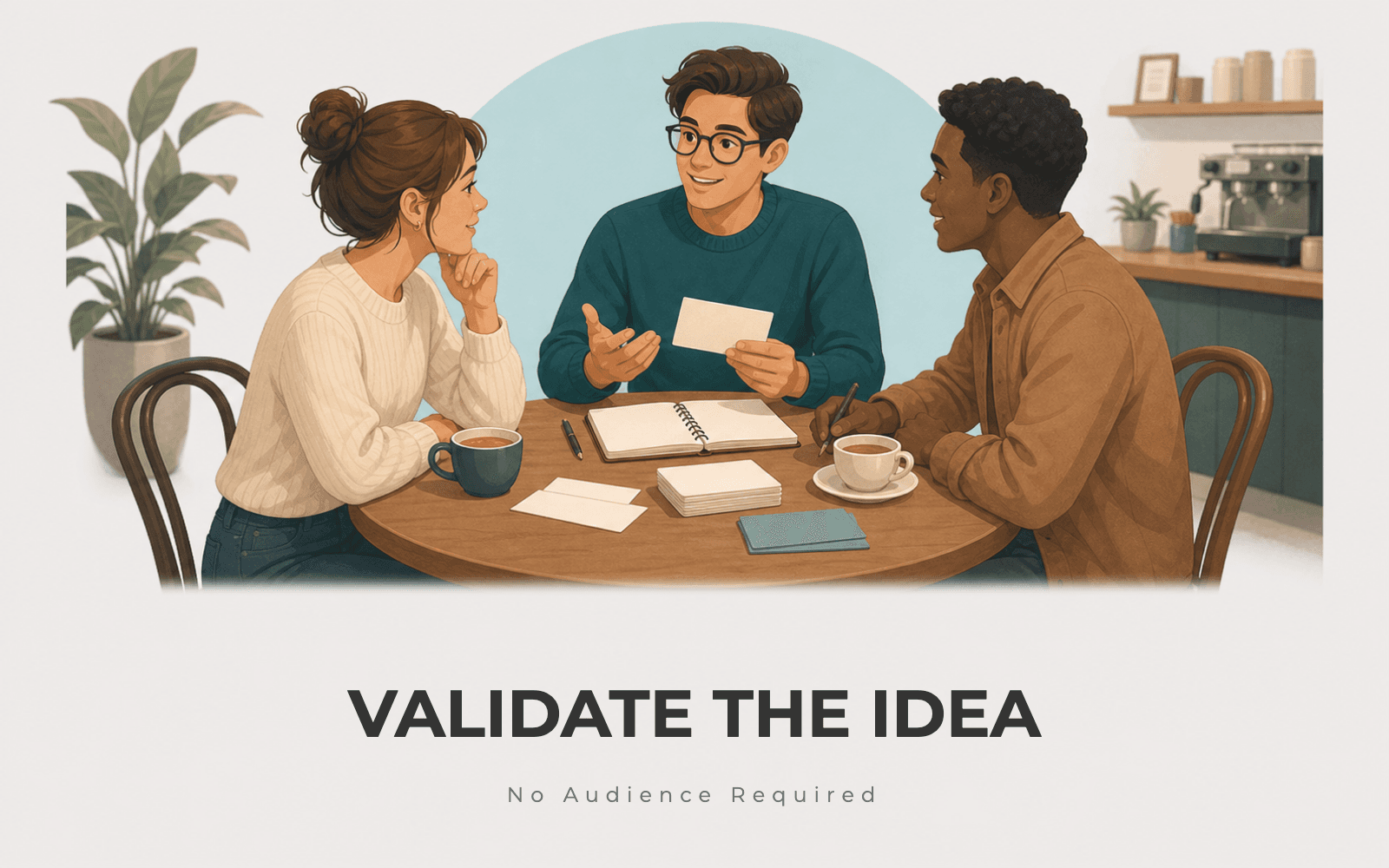
You do not need an audience to validate a startup idea. You need access to a specific type of customer, a clear hypothesis, and enough discipline to test behavior instead of collecting encouragement.
An audience can help distribution later, but it can also hide weak demand. If people like your posts but will not take a call, share a painful story, join a waitlist, or pay for a pilot, the idea is not validated.
This guide is for the founder starting from zero reach in 2026. The process uses direct outreach, customer interviews, public problem signals, small landing pages, and manual offers to find out whether the idea deserves more time.
Key Takeaways
-
No audience does not mean no access. Start with reachable customers in public places, directories, communities, and existing workflows.
-
Validation means evidence that customers have the problem and will change behavior to solve it.
-
Ask about the last time the problem happened before pitching your solution.
-
Use a manual or concierge offer before building software.
-
Decide in advance what signal is strong enough to keep going.
The No-Audience Validation Rule
When you have no audience, your advantage is focus. You are not broadcasting to everyone. You are choosing a narrow customer and learning from a small number of real conversations.
A useful validation process has three layers: problem evidence, solution evidence, and buying evidence. Problem evidence shows the pain is real. Solution evidence shows your approach is credible. Buying evidence shows the customer will give money, time, data, or reputation to solve it.
Do not skip to buying evidence before understanding the problem. But do not stay in interview mode forever either. The point is to move from conversation to commitment.
Define the Customer Before the Idea
A vague audience makes validation impossible. The tighter the customer definition, the easier it is to find people, write outreach, and understand the pattern in their answers.
This section is a gate, not a decoration. If the founder cannot complete it in plain language, the idea is probably still too vague for product, marketing, or fundraising work. Slow down here and turn the point into an artifact the company can reuse: a note, checklist, customer definition, scorecard, outreach list, weekly review prompt, or decision memo.
The practical move: Write a one-sentence customer definition that includes role, situation, trigger, and current workaround. For example: independent gym owners who lose trial members after the first class and currently follow up manually. Make it concrete enough that someone else could inspect the work and understand what changed. If AI helps draft, summarize, or compare options, use it as a speed layer, then review the output against customer facts and founder judgment.
The signal to watch: You can name twenty real people or businesses that match the definition within one hour.
When that signal appears, write down what it means for the next task. The point is not to collect a nice insight. The point is to decide whether to continue, narrow, change, sell, build, or stop.
Avoid Starting with broad groups like small businesses, creators, parents, or startups. Those are markets, not testable customer segments.. The common failure mode is treating this as a planning exercise instead of a market-facing loop. Every section should make the next customer conversation, offer, MVP, or operating decision sharper.
Write the Assumption Stack
Every idea rests on assumptions. Validation improves when you separate what must be true from what would merely be nice.
This section is a gate, not a decoration. If the founder cannot complete it in plain language, the idea is probably still too vague for product, marketing, or fundraising work. Slow down here and turn the point into an artifact the company can reuse: a note, checklist, customer definition, scorecard, outreach list, weekly review prompt, or decision memo.
The practical move: List the assumptions about the customer, pain, frequency, budget, timing, trust, and delivery. Circle the two that would kill the idea if false. Make it concrete enough that someone else could inspect the work and understand what changed. If AI helps draft, summarize, or compare options, use it as a speed layer, then review the output against customer facts and founder judgment.
The signal to watch: Your test is aimed at the riskiest assumption, not the easiest thing to build.
When that signal appears, write down what it means for the next task. The point is not to collect a nice insight. The point is to decide whether to continue, narrow, change, sell, build, or stop.
Avoid Testing a landing page headline when the real risk is whether the customer has budget or urgency.. The common failure mode is treating this as a planning exercise instead of a market-facing loop. Every section should make the next customer conversation, offer, MVP, or operating decision sharper.
Find Public Problem Signals
If a problem is real, traces of it usually exist before you ask anyone. Public signals help you avoid inventing pain in your own head.
This section is a gate, not a decoration. If the founder cannot complete it in plain language, the idea is probably still too vague for product, marketing, or fundraising work. Slow down here and turn the point into an artifact the company can reuse: a note, checklist, customer definition, scorecard, outreach list, weekly review prompt, or decision memo.
The practical move: Search reviews, communities, job posts, support forums, competitor testimonials, marketplace complaints, and social posts for repeated language around the problem. Make it concrete enough that someone else could inspect the work and understand what changed. If AI helps draft, summarize, or compare options, use it as a speed layer, then review the output against customer facts and founder judgment.
The signal to watch: You find the same pain described in different words by different people.
When that signal appears, write down what it means for the next task. The point is not to collect a nice insight. The point is to decide whether to continue, narrow, change, sell, build, or stop.
Avoid Mistaking loud complaints for paid demand. A problem can be annoying and still not worth solving commercially.. The common failure mode is treating this as a planning exercise instead of a market-facing loop. Every section should make the next customer conversation, offer, MVP, or operating decision sharper.
Interview for the Last Real Moment
Good validation interviews are about recent behavior. The last time the problem happened is more useful than opinions about a hypothetical product.
This section is a gate, not a decoration. If the founder cannot complete it in plain language, the idea is probably still too vague for product, marketing, or fundraising work. Slow down here and turn the point into an artifact the company can reuse: a note, checklist, customer definition, scorecard, outreach list, weekly review prompt, or decision memo.
The practical move: Ask when it last happened, what triggered it, what they tried, who was involved, what it cost, and what they would do if nothing changed. Make it concrete enough that someone else could inspect the work and understand what changed. If AI helps draft, summarize, or compare options, use it as a speed layer, then review the output against customer facts and founder judgment.
The signal to watch: The customer can describe a specific event, not just a general preference.
When that signal appears, write down what it means for the next task. The point is not to collect a nice insight. The point is to decide whether to continue, narrow, change, sell, build, or stop.
Avoid Asking whether they would use your idea. Most people are polite and bad at predicting future behavior.. The common failure mode is treating this as a planning exercise instead of a market-facing loop. Every section should make the next customer conversation, offer, MVP, or operating decision sharper.
Create a Manual Offer
A manual offer turns learning into a commercial test. It shows whether the customer wants the result before you invest in product infrastructure.
This section is a gate, not a decoration. If the founder cannot complete it in plain language, the idea is probably still too vague for product, marketing, or fundraising work. Slow down here and turn the point into an artifact the company can reuse: a note, checklist, customer definition, scorecard, outreach list, weekly review prompt, or decision memo.
The practical move: Package the outcome as a small paid service, audit, sprint, shortlist, template, setup, or concierge result. Make the promise narrow enough to deliver manually. Make it concrete enough that someone else could inspect the work and understand what changed. If AI helps draft, summarize, or compare options, use it as a speed layer, then review the output against customer facts and founder judgment.
The signal to watch: Someone agrees to a call, pays a deposit, shares data, or books the first delivery.
When that signal appears, write down what it means for the next task. The point is not to collect a nice insight. The point is to decide whether to continue, narrow, change, sell, build, or stop.
Avoid Calling a free favor validation. Free usage can teach workflow, but it does not prove willingness to pay.. The common failure mode is treating this as a planning exercise instead of a market-facing loop. Every section should make the next customer conversation, offer, MVP, or operating decision sharper.
Use a Landing Page as a Measurement Tool
A landing page is useful when it clarifies the offer and captures a specific action. It is weak when it becomes a design project.
This section is a gate, not a decoration. If the founder cannot complete it in plain language, the idea is probably still too vague for product, marketing, or fundraising work. Slow down here and turn the point into an artifact the company can reuse: a note, checklist, customer definition, scorecard, outreach list, weekly review prompt, or decision memo.
The practical move: Write the page around one customer, one painful moment, one outcome, proof of your approach, and one call to action. Make it concrete enough that someone else could inspect the work and understand what changed. If AI helps draft, summarize, or compare options, use it as a speed layer, then review the output against customer facts and founder judgment.
The signal to watch: Qualified visitors take the next step or reply with objections you can learn from.
When that signal appears, write down what it means for the next task. The point is not to collect a nice insight. The point is to decide whether to continue, narrow, change, sell, build, or stop.
Avoid Optimizing colors, animations, or logos before you know whether the promise is clear.. The common failure mode is treating this as a planning exercise instead of a market-facing loop. Every section should make the next customer conversation, offer, MVP, or operating decision sharper.
Run a Small Outreach Test
No-audience validation usually requires direct outreach. That is useful because it forces the idea to survive outside your own channels.
This section is a gate, not a decoration. If the founder cannot complete it in plain language, the idea is probably still too vague for product, marketing, or fundraising work. Slow down here and turn the point into an artifact the company can reuse: a note, checklist, customer definition, scorecard, outreach list, weekly review prompt, or decision memo.
The practical move: Send a short, specific message to a small set of matching customers. Mention the observed problem, the concrete outcome, and a low-friction next step. Make it concrete enough that someone else could inspect the work and understand what changed. If AI helps draft, summarize, or compare options, use it as a speed layer, then review the output against customer facts and founder judgment.
The signal to watch: People reply with context, accept calls, forward the note, or ask about the offer.
When that signal appears, write down what it means for the next task. The point is not to collect a nice insight. The point is to decide whether to continue, narrow, change, sell, build, or stop.
Avoid Sending generic mass outreach. If the message could go to anyone, the learning will be poor.. The common failure mode is treating this as a planning exercise instead of a market-facing loop. Every section should make the next customer conversation, offer, MVP, or operating decision sharper.
Make a Go, Change, or Stop Decision
Validation only helps if it changes what you do next. Decide the threshold before emotion and sunk cost take over.
This section is a gate, not a decoration. If the founder cannot complete it in plain language, the idea is probably still too vague for product, marketing, or fundraising work. Slow down here and turn the point into an artifact the company can reuse: a note, checklist, customer definition, scorecard, outreach list, weekly review prompt, or decision memo.
The practical move: Set a decision rule such as two paid pilots, ten qualified problem interviews, or five strong sales calls in a defined window. Make it concrete enough that someone else could inspect the work and understand what changed. If AI helps draft, summarize, or compare options, use it as a speed layer, then review the output against customer facts and founder judgment.
The signal to watch: The data tells you whether to continue, narrow the segment, change the offer, or stop.
When that signal appears, write down what it means for the next task. The point is not to collect a nice insight. The point is to decide whether to continue, narrow, change, sell, build, or stop.
Avoid Extending the test forever because the idea still feels promising.. The common failure mode is treating this as a planning exercise instead of a market-facing loop. Every section should make the next customer conversation, offer, MVP, or operating decision sharper.
The Best Validation Asset Is a Clear Next Task
A founder with no audience can still create real evidence. The work is less glamorous than launching to a list, but it is often more honest.
The sequence is simple: define the customer, find problem signals, interview for behavior, package a manual offer, test it with direct outreach, and make a decision from the result.
That is why 100 Tasks AI treats startup building as a process. You do not need a giant audience to begin. You need the next validation task, enough context to do it well, and the discipline to let customer behavior update the plan.

Martin Bell
Startup-building guidance from the 100 Tasks framework.