Martin Bell12 Min ReadPublished Jul 13, 2026
Startup Landing Page Copy: A Section-by-Section Guide (2026)
A practical 2026 writing sequence for turning customer language into a clear promise, credible proof, and one decisive next step.
Good startup landing page copy guides a decision. It helps the right visitor answer, in order: Is this for me? Do you understand my problem? Is the promised outcome relevant? How does this work? Why should I believe you? What will happen if I take the next step?
Weak pages answer a different set of questions: What features did we build? Which adjectives sound impressive? How many sections can fit into a template?
You do not need clever copy to fix that. You need a clear customer, a credible promise, evidence, and the right sequence. This guide gives you a section-by-section writing system. Use every section only when it advances the decision. A short page with a coherent argument is stronger than a long page assembled from standard blocks.
Before the Page, Write the Message Brief
Do not start with the headline. First, complete these six lines using facts from interviews, sales calls, support notes, or observed work:
- Customer: We are speaking to ___, specifically when they are ___ .
- Painful moment: They currently struggle with ___, which causes ___ .
- Desired outcome: They want ___ without ___ .
- Alternative: Today they use ___, but it fails when ___ .
- Reason to believe: Our approach is credible because ___ .
- Next step: A qualified visitor should ___ .
Specificity lives in the second half of each sentence. “Finance teams that want faster reporting” is broad. “Finance leads at multi-entity startups who lose two days reconciling management reports after month-end” gives you a scene, cost, buyer, and timing.
If those details are guesses, pause and run customer validation conversations. Copy cannot compensate for an untested customer definition. It can only express what you know.
Section 1: The Hero Makes a Fast Relevance Decision
The hero needs four things: a customer-relevant outcome, enough context to understand it, one primary action, and an optional reason to believe.
A reliable structure is:
Get [specific outcome] without [costly current method].
[Product] helps [specific customer] [complete important job] by [distinct mechanism or boundary].
[Primary action]
Suppose a startup reviews field-service photos. A weak hero says:
AI-powered quality intelligence for modern operations.
A stronger version says:
Catch incomplete field jobs before they become repeat visits.
Review completion photos against your checklist and route uncertain cases to a supervisor before the technician leaves the area.
The stronger version names the failure, timing, workflow, and guardrail. It lets an operations manager recognize the job immediately.
Use “AI” in the headline only when the buying decision depends on it. Buyers usually care first about the result and risk. The mechanism can sit in the supporting line.
Your primary button should describe the real next step: Book a 20-minute workflow review, Start the sample audit, or Join the pilot. Avoid Get Started when the visitor cannot predict what starts.
Section 2: The Problem Shows You Understand the Current Reality
The problem section should not dramatize generic frustration. Describe the current workflow accurately enough that a buyer thinks, “Yes, that is where it breaks.”
Use a three-part sequence:
- Trigger: When does the problem appear?
- Workaround: What does the customer do now?
- Consequence: What becomes slower, riskier, or more expensive?
For example:
At the end of every reporting cycle, your team exports data from billing, banking, and the ledger. Someone repairs category differences by hand. Leaders wait for a pack that is already out of date, while finance carries the risk of one quiet mapping error.
This works because it describes an operating scene. It does not tell the reader to feel “overwhelmed.”
Use customer language where it is precise, but do not dump interview quotes onto the page. Synthesize repeated observations. If the problem needs a five-paragraph explanation, the customer may be too broad or the page may be trying to sell multiple products.
Section 3: The Outcome Makes the New State Concrete
Now show what changes after adoption. Keep this separate from features. Outcomes answer “What becomes true?” Features answer “What does the product contain?”
Write outcomes as observable changes:
- a manager reviews exceptions instead of every record
- a sales representative starts with a trusted account view
- a customer receives an answer in hours instead of days
- a founder knows which five prospects to contact next
Pair each major outcome with a boundary. “Automate compliance” is not credible. “Keep access-review evidence organized by control owner and flag missing approvals before the monthly review” is useful and believable.
Three outcomes are usually enough. Rank them by buying importance, not by how much engineering work they required. The smallest product feature can create the largest customer value.
Section 4: The Mechanism Explains Why Your Approach Can Work
Buyers need a simple model of how the product creates the outcome. This is the mechanism section: usually three to five steps from input to result.
For a recruiting workflow, that could be:
- Import applications for one approved role.
- Structure job-relevant evidence against the hiring rubric.
- Prepare a review summary with source references.
- Keep every interview and rejection decision with the recruiter.
Notice what this does not say: “Our proprietary platform leverages advanced intelligence.” A mechanism earns trust by making the workflow inspectable.
Show where customer effort is required. If implementation needs a data export, a 45-minute setup, or weekly approval, say so. Hiding the work may increase clicks and destroy sales calls.
This section is also the right place to name a distinctive constraint: human approval, a fixed turnaround, one integrated data source, or delivery within an existing tool. A constraint can be more persuasive than an exaggerated capability because it shows the product has been designed around the buyer's reality.
Section 5: Proof Reduces the Specific Doubt You Created
Proof is not a logo strip by default. Choose evidence that answers the buyer's next doubt.
Use this proof ladder, from early to strong:
- Demonstration: A realistic sample, teardown, calculation, or before-and-after artifact.
- Founder evidence: Relevant experience, a documented process, or direct access to the problem.
- Customer language: A specific quote describing what changed.
- Behavior: Repeat usage, renewal, referrals, or adoption across a team.
- Measured outcome: A result with baseline, timeframe, scope, and method.
An early startup may not have measured customer outcomes yet. Do not manufacture authority. Show the workflow, publish a sample, name the limitations, and invite a bounded pilot. The landing page MVP examples explain how a page can test meaningful commitment before the full product exists.
Make proof adjacent to the claim it supports. A security statement belongs near the data-handling explanation. A quote about implementation belongs near onboarding. One giant testimonial section forces the reader to connect unrelated evidence on their own.
When using numbers, include context. “Cut review time by 42%” is incomplete. “In a four-week pilot covering 600 support tickets, the team reduced first-pass triage time from 11 to 6.4 hours per week” is inspectable. Use the latter only if you can substantiate it.
Section 6: Objections Let the Buyer Continue the Argument
Objections are not annoyances to overcome. They are conditions the buyer needs resolved before moving forward.
Collect the real ones from calls. They usually fall into five groups:
- Fit: Does this work for our team, volume, or use case?
- Effort: How much setup and behavior change is required?
- Risk: What happens with errors, data, or sensitive decisions?
- Alternative: Why not keep the spreadsheet, hire a person, or use an existing feature?
- Timing: Why solve this now?
Answer with a fact, process, or boundary. For example:
What if the system is uncertain? It routes the case to your named reviewer with the source material attached. It does not send or approve the result automatically.
That is better than “Our technology is highly accurate.” The first answer explains what happens when accuracy is imperfect.
You can format this as short objection cards, a comparison table, or a section titled What your team keeps control of. Choose the form that matches the fear. Do not add a generic question list merely because landing page templates include one.
Section 7: The Offer Defines What the Visitor Is Choosing
The offer section turns interest into a concrete exchange. Explain:
- what the customer receives
- who it is designed for
- the relevant scope or limits
- implementation or delivery timing
- price or the reason pricing requires a conversation
- what happens immediately after the action
For an early B2B pilot:
Four-week support triage pilot
For support teams handling 1,000–5,000 monthly tickets. We configure one ticket category, run in approval-only mode, review errors weekly, and deliver a rollout recommendation. Fixed pilot fee: €5,000. After booking, you will receive a workflow questionnaire and choose a technical review time.
The point is not that every page must publish pricing. The point is that the visitor understands the object they are evaluating. “Contact sales” beneath a feature grid is not an offer.
For self-serve software, show plan differences around usage, workflow, service, or risk—not arbitrary feature withholding. For a service, state inputs, outputs, revision limits, and turnaround. For a waitlist, explain what access means and what the company will do with the visitor's information.
Section 8: Risk Reversal Must Match the Actual Risk
Ask what the buyer believes could go wrong. Then reduce that risk without making a promise you cannot keep.
If the fear is wasted setup, offer assisted migration or a sample import. If the fear is poor fit, use a qualification call or small pilot. If the fear is quality, show approval gates and a defined correction process. If the fear is financial, use a bounded first engagement rather than a sweeping guarantee.
Avoid universal “money-back guarantee” language when the customer must provide data, access, or participation for the outcome. Clear responsibilities protect both sides. A credible boundary often creates more trust than a dramatic guarantee.
This section can be only two sentences. Its job is to remove a real barrier, not create another decorative band.
Section 9: The Final CTA Restates the Decision, Not the Slogan
At the end of the page, the visitor should not need to scroll upward to remember the promise. Restate three things: the outcome, fit, and immediate next step.
If you manage multi-site field operations and repeat visits are rising, bring one recent job type to a 20-minute workflow review. We will map the current quality check and tell you whether a 100-job pilot is a sensible next step.
Button: Review my workflow
That is a useful invitation even for a cautious buyer. It says who should act, what to bring, what will happen, and what is not guaranteed.
Use one primary action throughout the page. A secondary action can serve visitors who are genuinely earlier—such as viewing a sample—but five equal buttons create five unanswered decisions.
Put the Sections in the Order Your Buyer Needs
The order above is a default, not a law. A familiar low-risk product may move directly from hero to demonstration. A high-trust service may need founder evidence earlier. A new category usually needs more problem and mechanism explanation. An urgent operational tool may lead with measurable stakes.
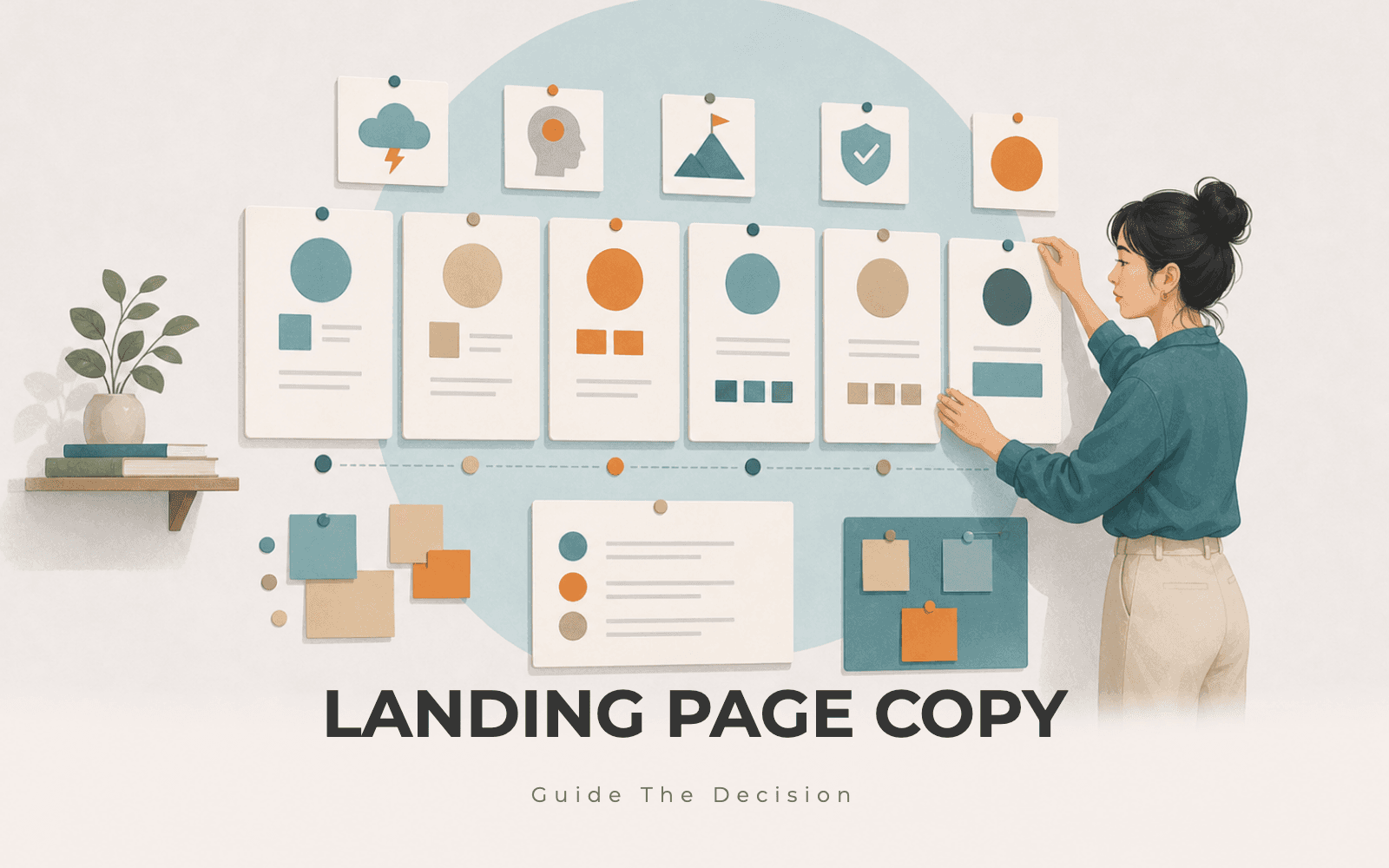
You can learn a lot from a simple card sort. Put each section on paper and ask: what question does this answer? Then arrange the cards in the order a skeptical qualified buyer would ask those questions. This creates a customer-centered narrative without forcing the page into a theatrical story arc.
Delete any section that cannot name its buyer question. Repeated benefit sections often exist because no one made a decision about hierarchy.
Edit With the Specificity and Deletion Tests
On the first edit, underline every phrase a competitor could use unchanged: save time, streamline workflows, all-in-one, powerful insights, seamless, built for modern teams. Replace each with the object, moment, action, or boundary that makes your claim yours.
On the second edit, remove every paragraph that does not change the decision. Keep enough detail to explain risk; delete repetition disguised as reassurance.
On the third edit, read the page aloud. Shorten sentences that need a second breath. Replace internal category names with words customers use. Check that each pronoun has a clear subject.
Finally, show the draft to five plausible customers. Ask them:
- Who is this for?
- What problem does it solve?
- What will happen differently?
- What concerns would stop you?
- What do you expect after pressing the button?
Do not explain the page while they answer. Their confusion is the test result.
First-Party Message Teardown: 100 Tasks AI
100 Tasks AI's current approved message is: “Systematically launch and scale your startup with AI in 2026.” The category is an AI-native startup operating system, not a generic chatbot or course. The mechanism becomes tangible through 3 stages, 15 substages, and 100 tasks. Credibility comes from Martin Bell's venture-building background, 120+ startups launched or supported, and 25,000+ founders and startups reached by the legacy framework.
That architecture works because each layer answers a different question: outcome, category, mechanism, and proof. The page still has to show who the system fits, what the next step is, and how the AI execution layer uses company context. The proof must support the process; it cannot imply that every founder receives the same result.
This is a teardown of current approved first-party messaging, not a fabricated before-and-after conversion case. Add a historical comparison only when the earlier copy, date range, traffic source, and measured outcome are available.
Use the value-proposition examples to shape the promise and the startup positioning examples to choose the market frame before translating either into page sections.
Your One-Page Copy Worksheet
Draft in this order, even if the final page order changes:
- Customer and painful moment
- Current workaround and consequence
- Desired observable outcome
- Distinct mechanism and boundaries
- Strongest relevant evidence
- Top three objections and factual answers
- Offer, scope, timing, and price logic
- Risk-reversal process
- Primary action and what happens next
- Hero headline and supporting line
Writing the hero last prevents it from becoming an unsupported slogan.
Once the page is live, do not wait for broad traffic to judge it. Send it to likely customers, use it in outreach, and listen to how they describe the offer back to you. The guide to finding your first ten customers is a practical companion when you do not already have an audience.
100 Tasks AI can help preserve the customer language, brand voice, objections, proof, and follow-up tasks that inform each revision. The durable advantage is not having AI generate more adjectives. It is keeping the page connected to what the company has actually learned.
A landing page succeeds when the right buyer can make a better decision. Give them the sequence, evidence, and clarity to do it.

Martin Bell
Founder of 100 Tasks. Martin Bell has launched or supported 120+ startups and turned Rocket Internet venture-building discipline into a step-by-step system used by 25,000+ founders and startups.