Martin Bell11 Min Read
How to Find Your First 10 Customers With No Network (2026)
A 2026 founder playbook for reaching ten real customers through focus, useful outreach, and small proof loops.
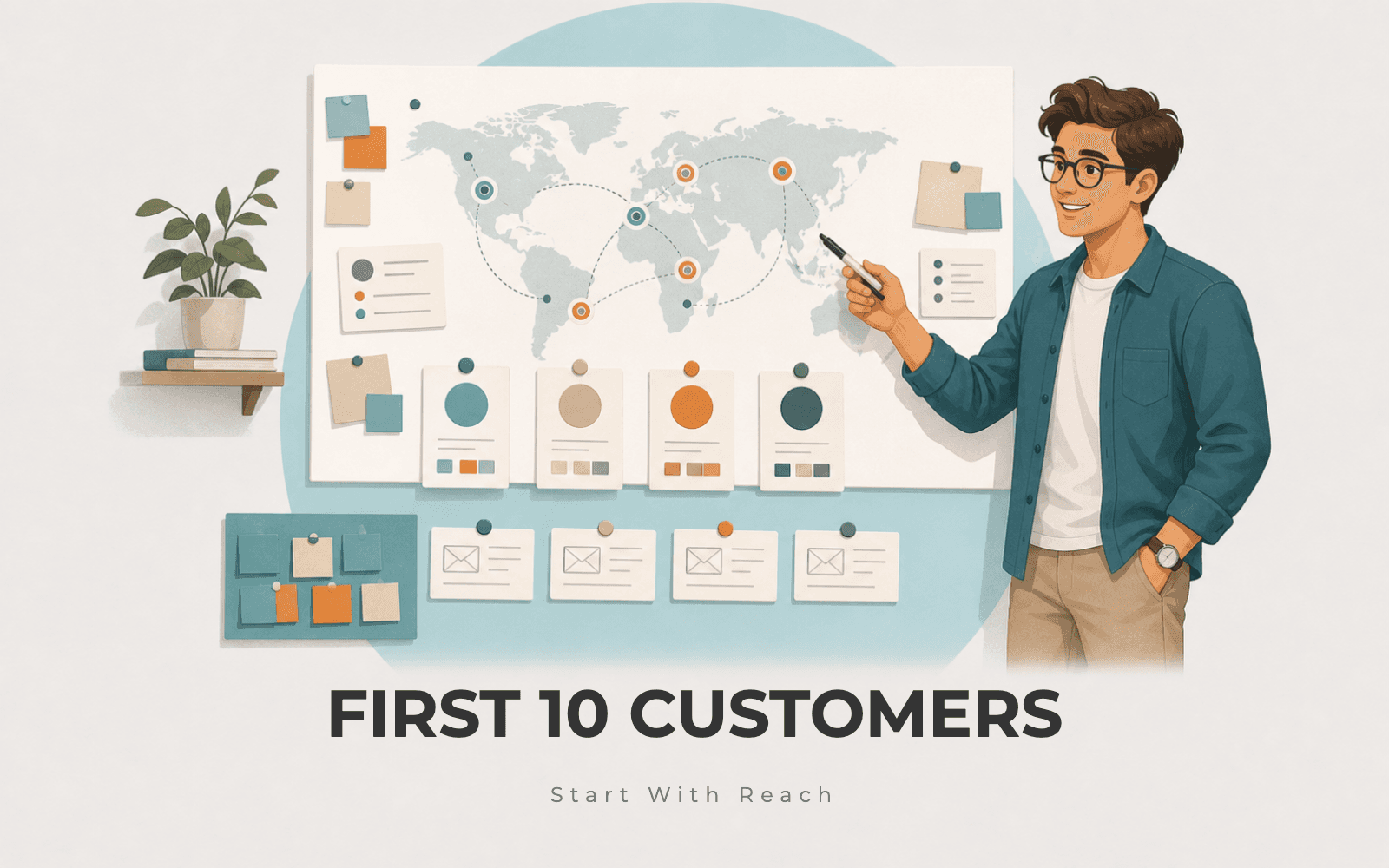
Your first ten customers rarely come from a polished funnel. They come from a narrow customer definition, a specific promise, useful outreach, and enough follow-up to learn what the market is telling you.
Having no network is a constraint, but it is not an excuse. In 2026, founders can find public directories, communities, review sites, podcasts, newsletters, social posts, and job listings that reveal who has a problem and how they describe it.
This guide gives you a practical path to the first ten customers without pretending cold outreach is easy or glamorous. The goal is not to blast strangers. The goal is to reach the right people with a useful reason to talk.
Key Takeaways
-
The first ten customers come from focus before scale.
-
A narrow segment makes outreach, proof, and referrals easier.
-
Use public problem signals to write messages that feel relevant.
-
Track every reply, objection, and no-response pattern.
-
The fastest path is usually direct conversations, not content volume.
What Counts as a First Customer
A customer is someone who gives something meaningful: money, time, data, access, reputation, or repeated usage. For a paid business, payment is the strongest signal, but early pilots can still matter when the commitment is real.
Your first ten should teach you the market. They should not all be friends, favors, or people who would support anything you do. You need customers close enough to the target segment that their objections and buying behavior can shape the company.
Treat the first ten as a learning cohort. You are building the offer, proof, onboarding, delivery, and follow-up at the same time.
Start With One Painful Segment
A broad market hides the buyer. A narrow segment tells you where to look and what language to use.
This section is a gate, not a decoration. If the founder cannot complete it in plain language, the idea is probably still too vague for product, marketing, or fundraising work. Slow down here and turn the point into an artifact the company can reuse: a note, checklist, customer definition, scorecard, outreach list, weekly review prompt, or decision memo.
The practical move: Define the customer by role, business type, trigger, and current workaround. Keep narrowing until you can list real names or companies. Make it concrete enough that someone else could inspect the work and understand what changed. If AI helps draft, summarize, or compare options, use it as a speed layer, then review the output against customer facts and founder judgment.
The signal to watch: You can source at least one hundred matching prospects from public channels.
When that signal appears, write down what it means for the next task. The point is not to collect a nice insight. The point is to decide whether to continue, narrow, change, sell, build, or stop.
Avoid Choosing a segment because it sounds strategic while having no way to reach it.. The common failure mode is treating this as a planning exercise instead of a market-facing loop. Every section should make the next customer conversation, offer, MVP, or operating decision sharper.
Write a Specific First Offer
Customers do not buy your ambition. They buy a result they understand.
This section is a gate, not a decoration. If the founder cannot complete it in plain language, the idea is probably still too vague for product, marketing, or fundraising work. Slow down here and turn the point into an artifact the company can reuse: a note, checklist, customer definition, scorecard, outreach list, weekly review prompt, or decision memo.
The practical move: Write the offer in one sentence: I help this customer achieve this outcome in this timeframe without this pain. Make it concrete enough that someone else could inspect the work and understand what changed. If AI helps draft, summarize, or compare options, use it as a speed layer, then review the output against customer facts and founder judgment.
The signal to watch: A stranger can repeat the offer back without asking what you actually do.
When that signal appears, write down what it means for the next task. The point is not to collect a nice insight. The point is to decide whether to continue, narrow, change, sell, build, or stop.
Avoid Pitching a platform, tool, or vision before the immediate outcome is clear.. The common failure mode is treating this as a planning exercise instead of a market-facing loop. Every section should make the next customer conversation, offer, MVP, or operating decision sharper.
Lead With a Useful Observation
Cold outreach improves when it starts with evidence that you understand the customer situation.
This section is a gate, not a decoration. If the founder cannot complete it in plain language, the idea is probably still too vague for product, marketing, or fundraising work. Slow down here and turn the point into an artifact the company can reuse: a note, checklist, customer definition, scorecard, outreach list, weekly review prompt, or decision memo.
The practical move: Reference a public signal, repeated problem, workflow bottleneck, or relevant trigger before introducing the offer. Make it concrete enough that someone else could inspect the work and understand what changed. If AI helps draft, summarize, or compare options, use it as a speed layer, then review the output against customer facts and founder judgment.
The signal to watch: Replies include detail, correction, or curiosity rather than only unsubscribe energy.
When that signal appears, write down what it means for the next task. The point is not to collect a nice insight. The point is to decide whether to continue, narrow, change, sell, build, or stop.
Avoid Fake personalization. Mentioning a company name is not the same as relevance.. The common failure mode is treating this as a planning exercise instead of a market-facing loop. Every section should make the next customer conversation, offer, MVP, or operating decision sharper.
Create a Small Proof Asset
When you lack a network, proof has to be useful before it is famous.
This section is a gate, not a decoration. If the founder cannot complete it in plain language, the idea is probably still too vague for product, marketing, or fundraising work. Slow down here and turn the point into an artifact the company can reuse: a note, checklist, customer definition, scorecard, outreach list, weekly review prompt, or decision memo.
The practical move: Build a teardown, checklist, comparison, mini case study, benchmark, or before-and-after example for the segment. Make it concrete enough that someone else could inspect the work and understand what changed. If AI helps draft, summarize, or compare options, use it as a speed layer, then review the output against customer facts and founder judgment.
The signal to watch: Prospects engage with the proof asset and it makes the sales conversation easier.
When that signal appears, write down what it means for the next task. The point is not to collect a nice insight. The point is to decide whether to continue, narrow, change, sell, build, or stop.
Avoid Waiting for big logos before showing how you think.. The common failure mode is treating this as a planning exercise instead of a market-facing loop. Every section should make the next customer conversation, offer, MVP, or operating decision sharper.
Ask for a Conversation, Not a Marriage
The first ask should match the trust level. A stranger may not be ready to buy, but they may answer a sharp question.
This section is a gate, not a decoration. If the founder cannot complete it in plain language, the idea is probably still too vague for product, marketing, or fundraising work. Slow down here and turn the point into an artifact the company can reuse: a note, checklist, customer definition, scorecard, outreach list, weekly review prompt, or decision memo.
The practical move: Use a low-friction call, audit, pilot, or reply question tied to the observed pain. Make it concrete enough that someone else could inspect the work and understand what changed. If AI helps draft, summarize, or compare options, use it as a speed layer, then review the output against customer facts and founder judgment.
The signal to watch: Prospects agree to a next step that lets you learn and potentially sell.
When that signal appears, write down what it means for the next task. The point is not to collect a nice insight. The point is to decide whether to continue, narrow, change, sell, build, or stop.
Avoid Sending a long pitch deck to people who have not confirmed the problem.. The common failure mode is treating this as a planning exercise instead of a market-facing loop. Every section should make the next customer conversation, offer, MVP, or operating decision sharper.
Follow Up With Context
Most first-customer work happens after the first message. Follow-up should add context, not guilt.
This section is a gate, not a decoration. If the founder cannot complete it in plain language, the idea is probably still too vague for product, marketing, or fundraising work. Slow down here and turn the point into an artifact the company can reuse: a note, checklist, customer definition, scorecard, outreach list, weekly review prompt, or decision memo.
The practical move: Send a second note with a useful example, answer a likely objection, or share a smaller ask. Make it concrete enough that someone else could inspect the work and understand what changed. If AI helps draft, summarize, or compare options, use it as a speed layer, then review the output against customer facts and founder judgment.
The signal to watch: Follow-ups produce replies because they are relevant to the original reason for outreach.
When that signal appears, write down what it means for the next task. The point is not to collect a nice insight. The point is to decide whether to continue, narrow, change, sell, build, or stop.
Avoid Automated nags that make the founder look careless.. The common failure mode is treating this as a planning exercise instead of a market-facing loop. Every section should make the next customer conversation, offer, MVP, or operating decision sharper.
Turn Every Customer Into a Learning Loop
The first ten customers should improve the next ten.
This section is a gate, not a decoration. If the founder cannot complete it in plain language, the idea is probably still too vague for product, marketing, or fundraising work. Slow down here and turn the point into an artifact the company can reuse: a note, checklist, customer definition, scorecard, outreach list, weekly review prompt, or decision memo.
The practical move: After each conversation or sale, record the trigger, objection, words used, proof needed, and next offer adjustment. Make it concrete enough that someone else could inspect the work and understand what changed. If AI helps draft, summarize, or compare options, use it as a speed layer, then review the output against customer facts and founder judgment.
The signal to watch: Your pitch gets shorter, clearer, and more specific after each batch.
When that signal appears, write down what it means for the next task. The point is not to collect a nice insight. The point is to decide whether to continue, narrow, change, sell, build, or stop.
Avoid Chasing random segments because the first version did not work immediately.. The common failure mode is treating this as a planning exercise instead of a market-facing loop. Every section should make the next customer conversation, offer, MVP, or operating decision sharper.
The First 10 Are an Operating System, Not a Hack
Getting first customers with no network is uncomfortable because it removes the fantasy of passive discovery. That is useful. It forces the founder to choose a customer, write a clear promise, and learn from real replies.
The process compounds. One conversation improves the offer. One offer creates proof. One proof asset makes the next outreach warmer. One customer can lead to a referral or a clearer niche.
In 100 Tasks AI terms, this is the launch discipline: customer map, outreach, proof, follow-up, learning loop. The founder does not need fame to start. They need a reachable customer and a system for doing the work.
Sources and Further Reading
References for the current task.

Martin Bell
Startup-building guidance from the 100 Tasks framework.